
There's a specific kind of frustration I used to feel constantly: sitting down at 8:45 p.m. with two hours of free time, starting a game everyone told me was great, and realizing somewhere around 9:30 that I'd spent forty-five minutes on tutorials, cutscenes, and menu navigation without actually doing anything that felt like playing. That feeling — of your evening slipping away while a game warms up — is what I now use as my primary filter. Indie games that respect your time are not just short. They're designed so that the minutes you give them actually count.
Over the years, I've kept a running list of games that clear this bar. Not games that are merely short. Not games that rush you. Games that understand something fundamental: a busy adult player is making a real trade when they choose to spend their evening with your work. These five are the ones I recommend most often when someone tells me they're tired of games that waste their time.
1. A Short Hike
Time to finish: 1.5 to 3 hours
A Short Hike is the game I recommend when someone has lost faith that games can be relaxing without being boring. You play as a young bird who needs to reach the top of a mountain to get phone reception. That's the whole premise. What happens along the way is a gentle, open-ended exploration of a small island full of small interactions — fishing, finding lost items, racing another bird, discovering hidden paths.
The reason it earns a spot on this list is not just its length. It's the density of satisfying moments within that length. There is no filler. Every few minutes, you find something new: a vista, a character with a funny line, a small gameplay surprise. The game trusts you to explore at your own pace and never punishes you for wandering. You can finish it in a single evening and go to bed feeling like you actually experienced something complete.
I've recommended A Short Hike to at least five friends in the last two years. Every single one finished it. That's not an accident. It's what happens when a game respects the player's time from the first minute.
2. Unpacking
Time to finish: 3 to 5 hours
On paper, Unpacking sounds like it shouldn't work. You move into a series of homes over the course of a character's life, and you unpack boxes. You place objects on shelves, in drawers, on desks. That's the gameplay. But the way the game tells a story through the objects you handle — which books survive each move, which mugs keep showing up, which photos get placed on the bedside table — is quietly devastating in the best way.
What makes Unpacking respect your time is its structure. Each level is a self-contained session. You can unpack one home, feel the satisfaction of a completed space, and stop. There's no pressure to optimize. There's no fail state. The game lets you arrange things however feels right, which means the friction between you and the experience is nearly zero. It's one of the few games I've played where I never once looked at a clock, because the game never gave me a reason to.
3. Return of the Obra Dinn
Time to finish: 6 to 10 hours
Return of the Obra Dinn is the opposite of a low-effort game. It asks for real attention. You play as an insurance investigator in 1807, boarding a ghost ship to determine the fates of all sixty crew members. You do this by examining frozen moments of death, cross-referencing faces, names, and roles, and making deductions based on tiny details. It's demanding. But it never wastes your time.
Every minute you spend in Obra Dinn is a minute of actual investigation. There are no distractions, no side quests, no systems designed to stretch the runtime. The game is as long as your brain needs it to be, and then it ends. That's rare. Most puzzle games pad themselves with repetition or arbitrary difficulty spikes. Obra Dinn trusts you to think, and it rewards that thinking with one of the most satisfying deduction loops I've ever experienced.
It's not a game for every tired Tuesday night. But if you have a weekend afternoon and a cup of coffee, it will earn every minute of it.

4. Donut County
Time to finish: 2 to 3 hours
Donut County is a game about a hole in the ground that gets bigger as you swallow things. You start with small objects — a brick, a potted plant — and eventually swallow entire houses, vehicles, and people. It's silly, colorful, and surprisingly funny. But the reason it's on this list is that it understands something many games don't: a game can be short and still feel complete.
There's a story here, told through dialogue between levels, and it wraps up in a way that feels intentional rather than truncated. The puzzles are light but satisfying, and the whole thing moves at a pace that never overstays its welcome. I played through Donut County in two weekday evenings, and I never once felt like I was being rushed or shortchanged. That's the mark of a game that respects your time: it gives you a full experience in a compact space.
5. The Stanley Parable: Ultra Deluxe
Time to finish: Variable, but a satisfying first session can be 1 to 2 hours
The Stanley Parable is a game about choice, and about the illusion of choice, and about the strange relationship between a player and a narrator. The Ultra Deluxe edition expands the original with new content that interrogates the very idea of expansion. It's funny, clever, and at times surprisingly pointed about how games try to keep you playing longer than you need to.
The reason it belongs here is that it's one of the few games that actively comments on the way games waste your time. It knows you're a person with a life outside the screen, and it uses that knowledge to make jokes that land differently at age 36 than they did at 22. You can dip in for an evening, see a few endings, and walk away feeling like you've had a complete experience. You don't need to see everything to get the point — and the game itself will tell you that.
What These Games Have in Common
The five games on this list are very different from each other. A gentle hiking game, a quiet unpacking simulator, a demanding deduction mystery, a silly hole-in-the-ground puzzle, and a meta-commentary on choice. But they share a few qualities that matter more than genre.
They know when to end. None of these games stretch their ideas past their natural conclusion. They have a point to make or an experience to deliver, and when that's done, they stop.
They trust the player. No excessive hand-holding, no forced tutorials, no systems designed to keep you engaged through obligation rather than interest. They assume you're smart enough to figure things out, and they respect you enough to let you go when you're done.
They don't punish you for having a life. Save anytime, no time-gated content, no daily login bonuses, no mechanics that require you to maintain a schedule. You can step away for a week and come back without feeling like you've lost something.
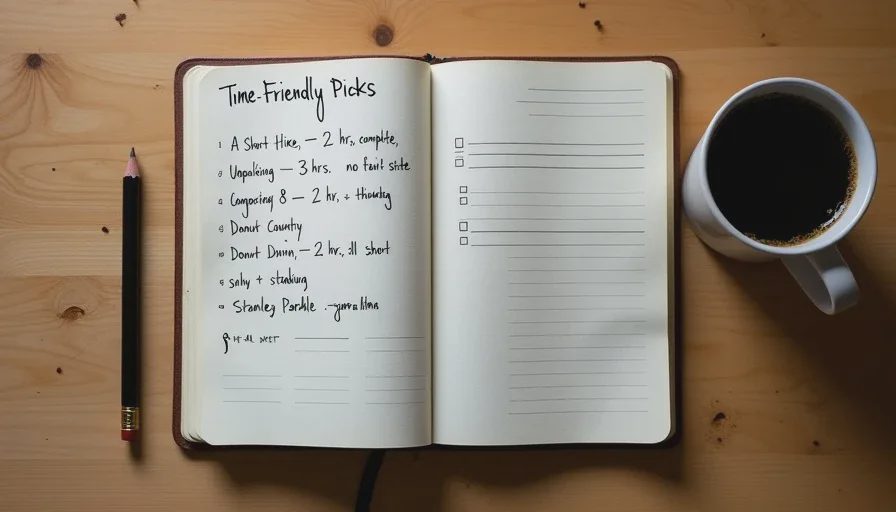
The next time you find yourself with a free evening and a library full of games that feel like obligations, try one of these. Not because they're short — though most of them are — but because they're built with a kind of respect for your time that's still too rare in this medium. A good game doesn't just deserve praise. It deserves your Tuesday night. These five actually earn it.




No notes yet — write the first.