
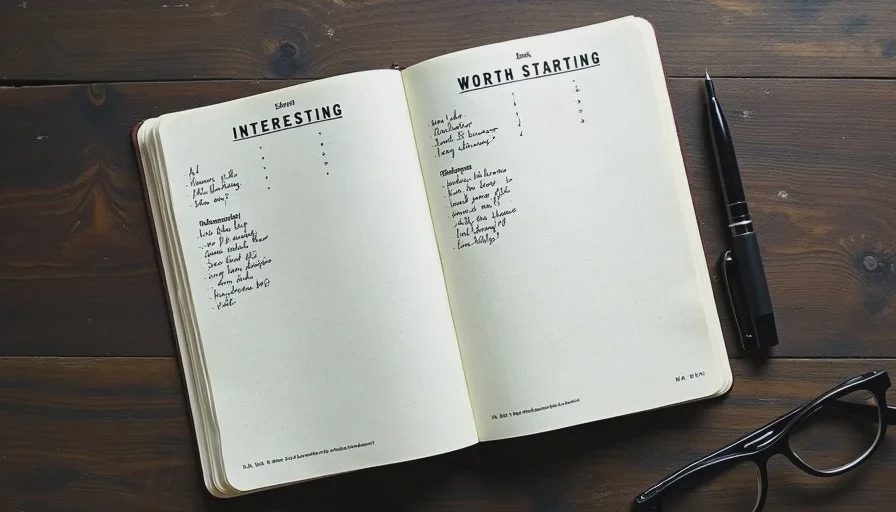
There's a phrase I hear constantly in indie game circles, and it has become one of my least favorite words in the entire medium. The word is "interesting." A game gets called interesting when it has an unusual mechanic, a bold narrative structure, an art style that breaks convention. And then someone says, "You should try it. It's really interesting."
I've learned to hear that word as a warning, not a recommendation. Because over the years, I've realized that "interesting" and "worth starting" are not the same thing — and confusing the two is one of the most reliable ways to waste a Tuesday night.
The Moment I Stopped Trusting "Interesting"
A few years ago, I was in a group chat with some friends, all of us adults with jobs and partners and limited time. Someone linked a game and said it was "one of the most interesting things I've played all year." That was enough for me. I bought it that night, made a coffee, and settled in.
The game was clever. I'll give it that. It had a mechanic I'd never seen before, something to do with manipulating the structure of the game world itself. The first thirty minutes were genuinely surprising. I kept thinking, "This is what people mean when they say games can be art."
And then, somewhere around the forty-five-minute mark, I hit a wall. Not a difficulty wall — I can handle a challenge. A different kind of wall. The kind where I realized the game had shown me its idea, and now I was going to spend the next several hours watching that idea repeat itself in slightly different configurations. The novelty was gone. What remained was the actual moment-to-moment experience, and it was thin.
I closed the game. I haven't opened it since. And I realized something: the game was interesting. It just wasn't worth starting — at least not for me, not with the time I had.
What "Interesting" Actually Tells You
"Interesting" is a word we use when a game does something we haven't seen before. It describes novelty, cleverness, formal ambition. These are real qualities. I'm not dismissing them. But here's what "interesting" doesn't tell you:
It doesn't tell you if the game is satisfying
A game can be clever and hollow at the same time. The cleverness can be the whole meal, and once you've tasted it, there's nothing left. I've played games with brilliant central ideas and almost no follow-through — the idea is the game, and the game is the idea, and after an hour you've seen everything the idea has to offer.
It doesn't tell you if the game respects your time
Some of the most interesting games I've ever played are also the most demanding. They ask you to hold complex systems in your head, to read long text, to re-learn controls every time you return. That's not a flaw if you have the bandwidth. But if you're coming home tired from work, an "interesting" game might be exactly the wrong choice.
It doesn't tell you who the game is for
"Interesting" is a universal claim. It suggests everyone should check it out. But most interesting games are actually quite specific. They're for players who want to think about game design, who enjoy formal experimentation, who have patience for a slow burn. That's a real audience. It's not everyone.

What "Worth Starting" Actually Means
When I say a game is "worth starting," I mean something more concrete. I mean that if you sit down with it on a Tuesday evening after dinner, the experience will give you something back before you go to bed. Not necessarily something easy, not necessarily something fast. But something real: a mechanic that feels good in your hands, a story that pulls you forward, a world that rewards your attention.
Worth starting is about the first forty-five minutes. Not the whole game — I can't promise you'll finish it, and I won't pretend I always do. But the first session matters enormously. Because that's when you decide whether to keep going. And for a busy adult, that decision has to be earned quickly.
Here's the test I now use. When I sit down with a new game, I ask myself one question after the first session: "Do I want to come back to this, or do I feel obligated to come back?" If it's obligation — because everyone says it's important, because I paid money, because I should "give it more time" — that's a bad sign. If it's genuine desire, the kind where I think about the game the next day and feel a small pull, that's worth starting.
The Three-Minute Conversation That Changed How I Recommend Games
I have a friend — let's call him Dan — who works in finance and plays games maybe four hours a week. He texted me once and said, "Everyone at work keeps telling me to play this game. Is it actually good or just interesting?"
That question stopped me. Because I knew exactly what he meant. He wasn't asking if the game was well made. He wasn't asking if it had novel ideas. He was asking if it would reward the specific, limited time he had.
I looked at the game he was asking about. It was a narrative experiment with an unusual structure and a lot of critical praise. And I realized I couldn't honestly tell him it was worth starting — not for him, not on his schedule. I told him it was interesting, and I explained what that meant, and I said he'd probably be better off with something more immediately rewarding.
He didn't buy the game. Later, he told me he was glad. He'd watched a video essay about it instead, and that gave him everything he wanted: the ideas, the discussion, the sense of having engaged with something smart. He didn't need to play it. The conversation was enough.
That's the thing about interesting games. Sometimes the best way to engage with them is to read about them, watch someone else play them, or absorb the ideas secondhand. You get the intellectual payoff without the time cost. Not every game needs to be played to be appreciated.
The Filter I Use Now
When I evaluate a game for Worth Your Night, I ask four questions in order:
1. What's the actual first hour like?
Not the trailer. Not the pitch. The real, minute-by-minute experience of starting the game for the first time. If I can't describe it clearly, I don't know the game well enough to recommend it.
2. Is there something here beyond the novelty?
Does the game have a hook beyond its central idea? If you stripped away the unusual part, would there still be a reason to play? If the answer is no, the game is interesting but probably not worth starting.
3. Does it survive contact with a tired adult?
This is the brutal test. A game that feels clever on a Saturday morning might feel like work on a Tuesday night. I don't judge games by their best-case scenario. I judge them by what happens when the player is already a little depleted.
4. Who is this actually for?
If the answer is "someone with more time than me," that's fine. I'll say so. But I won't pretend the game is worth starting for everyone just because it's interesting.
The Honest Conclusion
Some of my favorite games are interesting. Some of them are also worth starting. The ones that are both are rare, and they're the ones I'll recommend most enthusiastically.
But I've stopped pretending that cleverness is enough. A game that does something new deserves attention — from critics, from designers, from players who want to see the medium evolve. It doesn't automatically deserve your Tuesday night. The next time someone tells you a game is "interesting," ask them the follow-up: "But is it worth starting?"
Their answer will tell you everything you need to know.




No notes yet — write the first.