
There's a specific kind of evening where the desk is the enemy. You've spent all day in a chair, staring at a screen, and the thought of walking to another room to sit in another chair and stare at another screen feels like defeat. But you still want to play something. Not on your phone — something with a little more substance. Something that feels like a game, not a time-killer.
That's the evening the Steam Deck was built for. It's the couch, the bed, the recliner. It's gaming without the desk-shaped obligation. And when I say Steam Deck-friendly indie games for low-energy nights, I'm not just talking about games that run well on the hardware. I'm talking about games that match the posture of the evening — games you can play slouched, half-horizontal, with one eye on the screen and the other already drifting toward sleep.
Why the Steam Deck Changed My Weeknights
I bought a Steam Deck a couple of years ago, mostly out of curiosity. I didn't expect it to change my gaming habits as much as it did. But something happened the first week I had it: I played more games on weekday evenings than I had in months. Not because the Deck has some magical library — it plays the same games my PC does. Because it removed the friction between "I want to play something" and "I am now playing something."
That friction is real, and it's bigger than I thought. Sitting at a desk after work feels like extending the workday. The chair, the monitor, the keyboard — all of it is soaked in the energy of the job I just finished. The Steam Deck, by contrast, feels like leisure. It's in the living room. It's on the couch. It's next to the bed. It doesn't ask me to go anywhere or do anything except pick it up and press a button.
That might sound like a small thing. But for a busy adult with finite energy, small things are often the difference between playing a game and not playing a game.
What Makes a Game Steam Deck-Friendly for Low-Energy Nights
Not every indie game works well on the Deck, and not every game that runs well on the Deck works for a tired brain. The sweet spot is the intersection: games that are technically smooth on handheld hardware and designed in a way that respects your depleted state.
Readable at arm's length
This is the practical stuff. A game with tiny text, dense UI, or interface elements designed for a monitor two feet away is going to be miserable on a handheld screen. The best Deck-friendly games use large, legible fonts and clean, uncluttered interfaces. You shouldn't have to squint or hold the device six inches from your face to know what's happening.
No keyboard-and-mouse assumptions
Some games technically support controller input, but they were clearly designed for mouse and keyboard first. Menus feel awkward to navigate, actions require too many button presses, and the whole experience has a layer of translation between you and the game. A true Deck-friendly game feels native to the handheld — like it was always meant to be played this way.
Built for short, interruptible sessions
The Deck is a pick-up-and-put-down device. You play for twenty minutes, you set it down because something needs your attention, you pick it up again an hour later. A low-energy night game should accommodate that rhythm. Save anywhere, quick resume, no penalties for stepping away.
Not too visually demanding
The Deck's screen is good, but it's not a desktop monitor. Games with overly dense visual detail, tiny moving elements, or text buried in the environment will be harder to parse. The best handheld games are visually clear, with high contrast and readable silhouettes. You should be able to tell what's happening at a glance, even with the screen at a comfortable distance.

Five Games That Get It Right
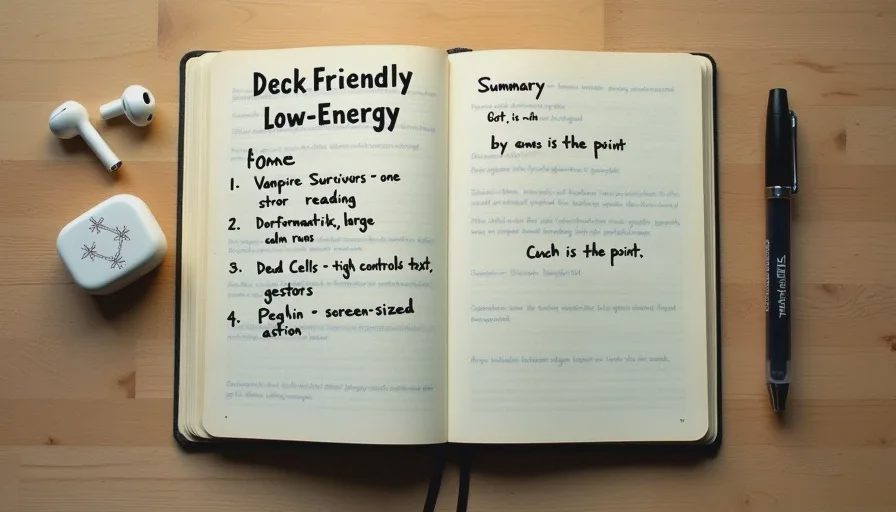
These are the games I've played on the Deck during low-energy evenings and thought: this is exactly what this device is for.
1. Vampire Survivors
Why it works: Vampire Survivors is almost absurdly simple. You move a character around a 2D arena while weapons fire automatically. Enemies swarm toward you. You collect experience gems, level up, and choose new weapons and upgrades from a menu that pauses the action. Your only actual input is movement.
That's it. That's the whole game. And it's perfect for a tired brain.
What makes Vampire Survivors brilliant on the Deck is that it demands almost nothing from you while still giving you a genuine sense of progression. Each run lasts up to thirty minutes, but you can quit anytime without losing your unlocks. The screen is readable from across the room. The controls are one joystick and occasional button presses. It's the gaming equivalent of a fidget toy that turns into a fireworks show.
2. Dorfromantik
Why it works: I've mentioned Dorfromantik before, but it deserves another mention specifically in the Deck context. It's a tile-placement game about building little landscapes — matching forests to forests, fields to fields, rivers to rivers. No enemies, no timer, no fail state. Just you, a stack of hexagonal tiles, and a slowly growing map.
On the Deck, Dorfromantik feels like it was always meant to be handheld. The tiles are large and readable. The interface is minimal. You can play for five minutes or an hour, and it feels the same. It's the game I reach for when I want to play something but don't want to play anything — the kind of experience that occupies your hands while your mind winds down.
3. Dead Cells
Why it works: Dead Cells is a roguelike action-platformer, and on the surface it seems like the opposite of a low-energy game. It's fast, demanding, and punishing. But here's the thing: it plays incredibly well on the Deck, and the run-based structure makes it surprisingly good for tired evenings.
The key is that Dead Cells gives you complete control over your engagement. You can do a quick run — fifteen to twenty minutes — and put it down. You can play for two hours if the energy is there. The controls are tight and responsive, which feels good even when you're tired. And because it's a roguelike, there's no story to remember, no quest to track, no context to rebuild. You just start a run, fight things, and see how far you get.
I wouldn't recommend Dead Cells on the night you can barely keep your eyes open. But if you're tired in the way that means "I want to do something active but not think too hard," it's a great fit.
4. Spiritfarer
Why it works: Spiritfarer is a management game about being the ferryperson for the dead. You build a boat, befriend spirits, help them resolve their unfinished business, and eventually say goodbye. It's warm, melancholy, and surprisingly funny in places.
What makes Spiritfarer work on the Deck is its pacing. The game never rushes you. You can spend an evening fishing, cooking, and chatting with your passengers, or you can push the story forward if you're feeling more engaged. The text is large enough to read comfortably on the handheld screen, and the controls are fully gamepad-friendly.
It's a game that meets you at whatever energy level you bring to it. On a low-energy night, that's exactly what you want.
5. Peglin
Why it works: Peglin is a roguelike that combines Peggle-style pachinko physics with turn-based RPG combat. You drop a ball into a field of pegs, it bounces around, and each peg it hits deals damage to an enemy below. Between shots, you collect relics that modify how your ball behaves.
It's the kind of game that works beautifully on a handheld because the action is inherently screen-sized. The pegs are large and readable. The physics are satisfying to watch. There's enough strategy to keep your brain lightly engaged — which relics to take, which targets to aim for — but not so much that it feels like work. It's the perfect middle ground between mindless and demanding.
What to Avoid on the Deck
The Deck is a wonderful device, but it's not a magic compatibility machine. Some games just don't work well on it, and the failure modes are predictable.
Desktop-first interfaces
If a game was designed for a monitor and mouse, it's going to fight the Deck. Small text, precise clicking, keyboard shortcuts — these are all signs that the developer wasn't thinking about handheld play. Check reviews before you buy. Other Deck players will tell you if the text is too small or the controls feel awkward.
Games that need constant precision
The Deck's joysticks are good, but they're not a mouse. If a game requires pixel-perfect aiming or rapid, precise cursor movement, you're going to be frustrated. Look for games that are generous with their aim assist or that were designed around controller input from the start.
Games that assume you'll play for hours at a stretch
Some games are built for long, continuous sessions. They have complicated systems that take time to re-learn, or they save infrequently, or they punish you for stepping away. These games don't fit the low-energy couch evening. You want something that plays well in twenty-minute chunks and doesn't make you pay for interruptions.
The Couch Is the Point
The Steam Deck didn't invent couch gaming, but it made it accessible in a way that no device has before. For a busy adult, that matters. It means the difference between playing a game after work and just scrolling your phone until bedtime.
The games I've listed here all understand what the Deck is for. They're readable, responsive, and respectful of your time. They don't ask you to sit up straight or lean forward. They let you slouch, sink into the cushions, and still have a genuine gaming experience while your brain slowly powers down.
That's not a small thing. It's the whole point. A good game doesn't just deserve your Tuesday night. It deserves to be played wherever you are when that Tuesday night finally arrives — even if you're horizontal, half-asleep, and holding the screen a little too close to your face.




No notes yet — write the first.