
There's a particular kind of tired that hits around 8 p.m. on a Wednesday. It's not the physical exhaustion of a long day, and it's not the mental fog of a bad night's sleep. It's the specific feeling of your brain running at half capacity — still awake, still capable, but not interested in learning new systems, tracking complex narratives, or making demanding decisions. You want to play something, but you don't want to work for it.
I've learned to treat that state as its own category. It's not the same as wanting a short game, or a finishable game, or a game that respects your time in the abstract. It's wanting a game that meets you where you are: tired, a little scattered, and unwilling to be punished for it.
Games to play when your brain is half offline are not lesser games. They're games that understand a specific kind of player moment. They don't ask you to be sharp. They don't ask you to remember what you were doing three sessions ago. They just give you something to do with your hands while your mind slowly powers down.
What "Brain Half Offline" Actually Feels Like
I know I'm in that state when I open my Steam library and immediately close any game that requires reading a tutorial. When the thought of managing an inventory makes me sigh. When a story-heavy game with subtitles feels like homework. When all I really want is to press a button and have something pleasant happen.
That's the test, really. Does the game ask for more than I have right now? If the answer is yes, it doesn't matter how good the game is. It's the wrong tool for this specific evening.
I've made the mistake too many times of forcing myself to play something "good" when what I needed was something easy. The result was always the same: twenty minutes of half-hearted engagement, then closing the game feeling more drained than when I started. The game didn't fail me. I failed to respect what my brain was telling me.
What to Look For in a Half-Offline Game
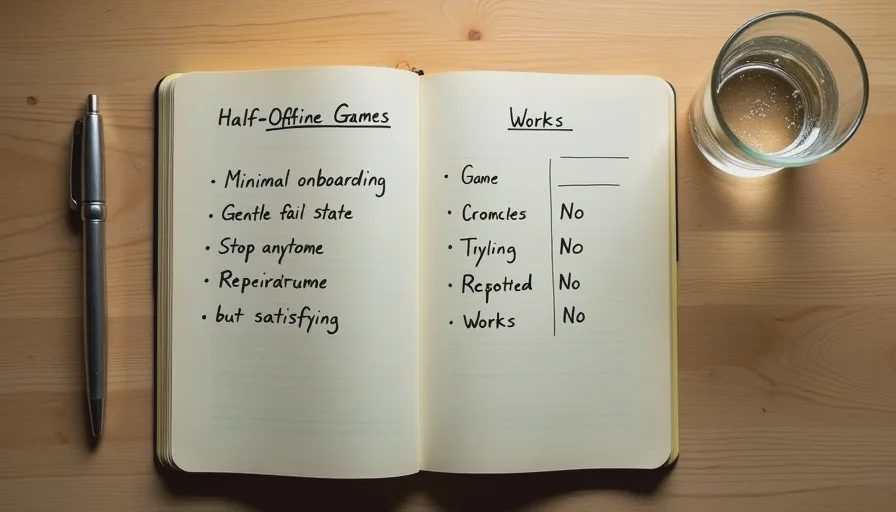
Over the years, I've identified a few qualities that make a game work in this state. They're not complicated, but they're specific.
Minimal onboarding
The game should explain itself in under a minute. Ideally, it should be self-explanatory within the first thirty seconds of play. If I have to read a tutorial screen or sit through a long introduction, it's already asking too much.
Repetitive but satisfying core loop
There's a difference between repetition that feels meditative and repetition that feels like grinding. A half-offline game should land on the first kind. The core action — cleaning a surface, placing a tile, arranging an object — should be inherently satisfying, so that doing it over and over feels soothing rather than tedious.
No fail state or very gentle fail state
Nothing ruins a tired evening faster than dying and losing progress. A half-offline game should either have no fail state at all, or it should make failure so low-stakes that it barely registers. You're not here to be challenged. You're here to exist in a pleasant space for an hour.
Stop whenever you want
The game should let you quit at any moment without penalty. No saving restrictions, no "you can't leave during a mission," no systems that punish you for stepping away. If you fall asleep with the controller in your hand, the game should be fine with that.
Four Games That Actually Work
These are the games I reach for when my brain is half offline. They've earned a permanent place in my library for one simple reason: they never ask for more than I have.
1. PowerWash Simulator
Why it works: The pitch is absurdly simple. You have a pressure washer, and you clean things. Driveways, houses, vehicles, playgrounds. Dirt comes off in satisfying little patches, and a satisfying little chime plays when you finish a section. There's no timer, no fail state, no stress. Just you and a dirty surface, slowly becoming clean.
What makes PowerWash Simulator perfect for a tired brain is that it gives you a sense of progress without demanding anything in return. The game tracks what percentage of each object you've cleaned, and watching that number climb is weirdly compelling. It's the kind of game that lets your mind wander while your hands do the work. I've finished entire podcasts while playing it, which is exactly the level of attention it asks for.
2. Dorfromantik
Why it works: Dorfromantik is a tile-placement game about building little landscapes. You draw hexagonal tiles and place them next to matching terrain — forests next to forests, fields next to fields, rivers next to rivers. It's quiet, gentle, and almost entirely without pressure. There's a scoring system, but you can ignore it entirely and just make pretty patterns.
The game's greatest asset is how easy it is to start. There's no tutorial to speak of, because the rules are obvious from the first tile. You can play for five minutes or an hour, and it feels the same. When your brain is half offline, that kind of flexibility is exactly what you need.
3. Townscaper
Why it works: Townscaper isn't really a game at all. It's a toy. You click on a featureless ocean, and a little house appears. Click next to it, another house appears, connected by a wall. Click above, a balcony. The game handles all the architectural logic for you, turning your random clicks into charming little towns with winding staircases and cozy courtyards.
There's no goal, no score, no fail state. You just click and watch something pleasant emerge. It's the digital equivalent of doodling in a notebook while half-watching television. For a tired brain, that's often exactly enough.
4. Sticky Business
Why it works: Sticky Business puts you in charge of a tiny sticker shop. You design stickers using a simple creator — pick a shape, choose colors, add small illustrations — and then pack orders for customers who write in with little stories about why they want a particular sticker. The creation tools are simple enough that you can make something decent without any artistic skill, and the order-packing loop is genuinely soothing.
What I appreciate about Sticky Business is how it respects the player's emotional state. The customer messages are warm and funny, and there's no pressure to optimize your shop or hit sales targets. You're just making little things and sending them to people who are happy to receive them. After a long day, that's a deeply calming loop.

The Trap of Games That Look Relaxing But Aren't
One warning before you go hunting for half-offline games: not everything with a calm aesthetic is actually calm to play. I've been burned by this more than once.
A game might have soft pastel colors and gentle music, but underneath that, it might be a demanding puzzle game that requires constant spatial reasoning. Or it might be a narrative game with long text and branching dialogue that asks you to remember who said what. Or it might be a farming sim with a dozen interconnected systems that slowly turn into spreadsheet management.
I fell into this trap with a minimalist puzzle game a while ago. It looked meditative — clean lines, muted colors, ambient sound. But the puzzles required real cognitive effort, and after twenty minutes I was more tired than when I started. The aesthetic had lied to me. I've since learned to look past the visual tone and ask the harder question: what does this game actually ask of me, minute to minute?
If the answer involves planning, memory, or complex decision-making, it's not a half-offline game. No matter how relaxing it looks.
The Deeper Value of Low-Friction Games
I used to think of these games as filler — something to play when I didn't have the energy for "real" games. I don't think that anymore. The half-offline evening is a real part of being an adult with a job and responsibilities. It's not a lesser version of myself. It's just a different one.
And there's something genuinely valuable about having games that meet you in that state. They give you a way to unwind without adding more demands to an already demanding day. They let you keep playing even when you're tired, which means you're more likely to come back to the hobby at all.
That's the thing about games that respect a tired brain. They don't just fill an hour. They keep you connected to the medium, gently, on the days when you might otherwise just scroll your phone and feel bad about it.
What to Try Tonight
If you're reading this after work, and your brain is already half offline, here's the short version: pick a game that asks for almost nothing and gives you something pleasant in return. PowerWash Simulator if you want visible progress. Dorfromantik if you want quiet pattern-making. Townscaper if you just want to click and watch something grow. Sticky Business if you want a small creative loop with low stakes.
All of them will let you stop whenever you want. All of them will be there tomorrow. And none of them will make you feel bad for being tired.
That's what the best half-offline games do. They don't demand that you rise to meet them. They come down to where you are, sit beside you for an hour, and let you breathe. A good game doesn't just deserve your Tuesday night. It deserves your tired Wednesday too — and these ones actually know it.




No notes yet — write the first.