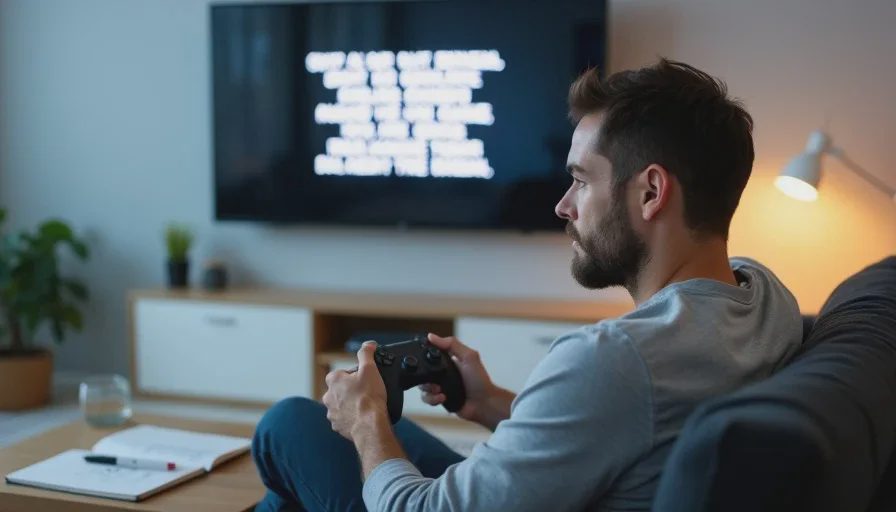
There's a specific kind of satisfaction that comes from finishing a game. Not just playing it, not just enjoying it, but actually reaching the end — seeing the credits roll, closing the game, and knowing you experienced everything it had to offer. For a long time, I assumed that satisfaction required a big time investment. A forty-hour RPG, a hundred-hour open world, something that demanded weeks of my life.
I was wrong. Some of the most complete gaming experiences I've ever had have come from games I finished in a weekend, sometimes in a single sitting. The best indie games you can finish in 8 hours or less are not lesser experiences. They're just more honest about what they're trying to do — and for a busy adult, that honesty is a gift.
Why Eight Hours Is the Magic Number
Eight hours is a useful frame. It's roughly one full workday. It's a solid weekend of play if you have a couple of hours each evening. It's long enough for a game to build something meaningful, but short enough that you can actually see the end from the beginning.
I've started tracking my playtime more carefully over the last few years, and the pattern is clear: the games I remember most fondly are the ones I actually finished. Not the ones I admired from a distance, not the ones I abandoned at hour twenty. The ones where I reached the credits and sat there for a moment, letting the whole thing settle.
Finishing matters. A complete story, a complete arc, a complete set of mechanics — these things land differently when they have a proper ending. And short games, by their nature, are built around that fact. They know they don't have a hundred hours to make their point, so they make it efficiently.
1. Inside
Time to finish: 3 to 4 hours
Inside is the game I recommend to people who think short games are shallow. It's a puzzle platformer from the studio behind Limbo, and it is one of the most tightly designed games I've ever played. There is no filler. Every scene advances the mood, the story, or the mechanics. Nothing is wasted.
What makes Inside remarkable is how much it communicates without words. The game tells its story through atmosphere, through environmental detail, through the way the world reacts to your presence. And then it ends — with a sequence that I won't spoil, but that I still think about years later.
I played Inside in two sittings. The first was a Tuesday night, about ninety minutes. The second was the following Thursday, another ninety minutes. I finished the game, sat back, and felt like I'd been through something genuinely affecting. The fact that it took less time than a single season of a TV show didn't diminish that at all.
2. What Remains of Edith Finch
Time to finish: 2 to 3 hours
What Remains of Edith Finch is a walking simulator, which is a term that undersells what it actually is. You play as Edith Finch, the last surviving member of a family with a tragic history, and you explore their sprawling house to learn how each relative died. Each death is rendered as a playable vignette, and each vignette has its own distinct mechanical and visual style.
The game is emotionally heavy. I'm not going to pretend otherwise. But it's also one of the most inventive pieces of storytelling I've experienced in any medium. One vignette in particular — involving a fish cannery and a fantasy world that slowly takes over — is the kind of thing that stays with you for years.
It's a game that respects your time in the best way: it gives you an enormous amount of meaning in a very small package. You can finish it in one evening and think about it for a week.

3. Celeste
Time to finish: 6 to 8 hours for the main story
Celeste is a precision platformer about climbing a mountain, and it's also one of the most honest depictions of anxiety and self-doubt I've seen in a game. The platforming is demanding — this is not a low-effort pick — but the game treats failure with unusual kindness. You respawn quickly. You lose almost no progress. The game wants you to succeed, and it respects the time you spend trying.
The main story can be completed in under eight hours, though the game offers plenty of optional challenge content if you want more. I recommend playing the main path and stopping when the credits roll. You'll have experienced a complete emotional arc, and you'll have earned it through gameplay that's genuinely satisfying.
What stuck with me about Celeste isn't just the difficulty or the story. It's how the game's mechanics reinforce its message. The mountain is hard. You will fail. But failure isn't a punishment here — it's part of the process. That's a lesson that lands differently at age 36 than it did at 20.
4. Firewatch
Time to finish: 4 to 6 hours
Firewatch takes place in a Wyoming national forest in 1989. You play as Henry, a man who has taken a summer job as a fire lookout to escape a complicated life. Your only real companion is Delilah, your supervisor, who talks to you over a handheld radio. The relationship between Henry and Delilah — funny, warm, complicated — is the heart of the game.
The structure is simple: you explore, you talk, you investigate a mystery that builds slowly and resolves in a way that divided players. I won't tell you which side I fall on, because the experience is worth having for yourself. What I will say is that Firewatch understands pacing. It knows when to push and when to let you breathe. And it ends, which is more than I can say for a lot of games.
5. Her Story
Time to finish: 2 to 4 hours
Her Story is a game that takes place almost entirely in front of a police database. You search for video clips of a woman being interviewed about a crime, and you piece together the truth from the fragments you find. That's it. No other mechanics, no other characters, no other locations.
It sounds like a gimmick, and in a way it is. But it's a gimmick that works because the game trusts you to think. The order in which you discover clips shapes your understanding of the story. Different players come away with different interpretations, and that ambiguity is the point. It's a game that makes you feel like a detective, not because you're solving puzzles, but because you're making connections.
Her Story is also deeply respectful of your time in a practical sense. You can save and quit at any point, and the game remembers what you've found. You can play in fifteen-minute chunks or binge the whole thing in one sitting. Either way, you'll finish it — and you'll probably want to talk to someone about it afterward.
What These Games Have in Common
The five games on this list are very different. A dystopian platformer, a family tragedy, a mountain-climbing metaphor, a forest mystery, a police database. But they share a few qualities that make them worth your time.
They were designed with an ending in mind. These games know what they're building toward. They don't sprawl. They don't pad. Every hour is in service of the conclusion.
They deliver a complete emotional experience. Not one of these games feels like a fragment. You finish them and you feel like you got what you came for.
They don't demand a second job. No battle passes, no daily quests, no systems that require you to maintain a schedule. You play them, you finish them, and then you're done. That's the point.
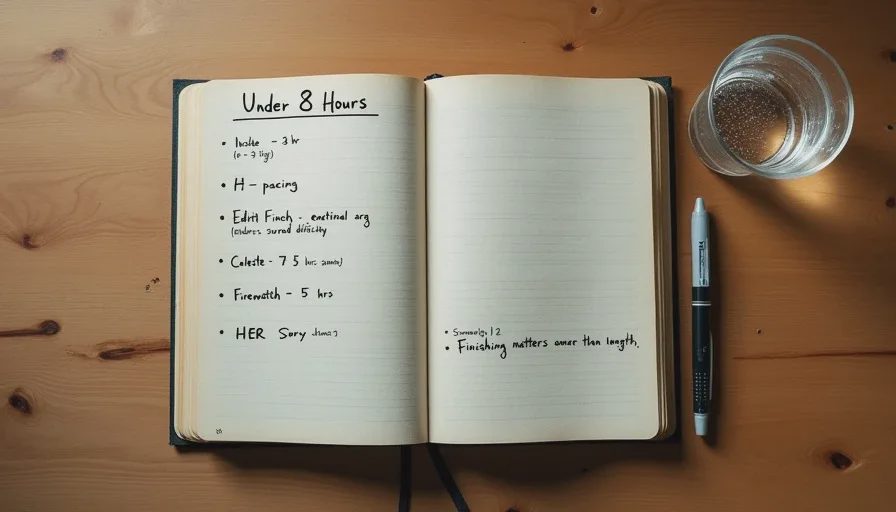
Eight hours is more than enough time for a game to matter. These five prove it. The next time you're staring at your library and feeling like you don't have time to start anything new, remember: some of the best experiences in the medium are waiting for you, and they won't take over your life. They'll just take one good evening, maybe two, and give you something back that stays.
A good game does not just deserve praise. It deserves your Tuesday night. These five earn it — and they'll give it back to you by morning.





No notes yet — write the first.