
Three Acclaimed Games I Respect More Than I Enjoyed
I want to be clear about something before I start: this is not a hit piece. The three games I'm about to discuss are all, by any reasonable measure, excellent. They have dedicated fanbases, critical acclaim, and a place in the conversation about what indie games can achieve. I'm glad they exist. I respect what they set out to do.
And I didn't enjoy playing any of them.
This is the column where I try to be honest about the gap between admiration and enjoyment. It's the easiest gap to ignore, because the culture around games encourages us to treat "this is good" and "I liked this" as the same thing. They're not. A game can be brilliant and still feel like a chore. A game can be important and still be a poor fit for your Tuesday night. Three acclaimed games I respect more than I enjoyed is my attempt to articulate that gap with specific examples.
Disco Elysium
Disco Elysium is one of the most ambitious narrative games ever made. It casts you as a detective with a fractured memory and a head full of voices — each one a different aspect of his psyche, all of them arguing about what to do next. The writing is genuinely extraordinary: sharp, funny, melancholy, and political in ways that most games wouldn't dare. It's the rare game that trusts the player to engage with ideas.
I respect Disco Elysium deeply. I think it pushed the medium forward, showed what dialogue-driven RPGs could be, and earned every bit of praise it received.
I also stopped playing after about eight hours and never went back.
Here's why. The game asks you to read constantly. Not just dialogue — paragraphs of internal monologue, environmental description, political theory, and philosophical digression. That's not a flaw. It's the core of the experience. But for a busy adult with tired eyes and limited evening hours, the prospect of sitting down to read for two hours after a day of reading emails felt less like leisure and more like homework. The writing is excellent, but excellent writing still demands a kind of attention I didn't always have left.
There's also a pacing issue that I felt keenly. The game gives you an enormous amount of freedom early on, which is wonderful until you realize you've spent ninety minutes exploring a single building and haven't advanced the central mystery. I respect the freedom, but it clashed with my need for a sense of momentum. I'd finish a session feeling like I'd done a lot without actually having done anything.
I'm glad Disco Elysium exists. I recommend it to friends who are looking for a game that reads like a novel. But I won't recommend it to someone who wants to feel like they made progress on a Tuesday night.
The Witness
The Witness is a puzzle game by Jonathan Blow, the creator of Braid. It takes place on an island filled with hundreds of line-drawing puzzles, all built around a single core mechanic: drawing a path from a start point to an endpoint through a grid, following rules that the game never explicitly explains. The joy of the game comes from discovering those rules yourself, through observation and experimentation.
I respect The Witness immensely. It's one of the purest expressions of a specific design philosophy I've ever seen: the idea that a game should teach through design rather than instruction, that understanding should be earned, not handed to you.
And I found it deeply exhausting.
The problem is that the game demands a very specific kind of mental focus that I rarely have on weekday evenings. Each puzzle is a small act of deduction, and the satisfaction comes from the moment of insight — the "aha" when you finally understand what a symbol means or how a rule works. But getting to that moment requires patience, and the gaps between insights can stretch for long minutes of staring at a screen, trying combinations, and getting nowhere.
On a Saturday afternoon with a clear head, that process is meditative. At 8 p.m. after a day of work, it feels like taking a logic exam. I respect the design philosophy, but I also know that I don't want to spend my limited free time feeling like I'm being tested.
There's also something about the game's refusal to acknowledge progress that wore on me. There's no story, no characters, no external rewards. Just you and the puzzles and the island. That purity is admirable, but it also meant that when I finally solved a puzzle, the only person who noticed was me. And I was too tired to care.
I respect The Witness. I might even love it if I had a month with no other obligations. But for a busy adult looking for something that gives back a little more readily, it's a hard fit.
Hollow Knight
Hollow Knight is a Metroidvania set in a ruined underground kingdom called Hallownest. It's known for its hand-drawn art, its melancholy atmosphere, its deep combat, and its punishing difficulty. The game gives you a huge interconnected world to explore, and it trusts you to find your own way through it — no quest markers, no clear objectives, just you and a map and a kingdom full of secrets.
I respect Hollow Knight enormously. It's one of the most polished, atmospheric, and mechanically satisfying games I've ever played. The art direction alone deserves awards, and the way it handles exploration — slowly opening up the map, revealing shortcuts and connections — is masterful.
I also found it deeply frustrating.
The difficulty is part of it. Hollow Knight is hard, and it's hard in a way that punishes you for dying: you lose your currency, you respawn far away, and you have to fight your way back to where you died to recover what you lost. That's a classic Metroidvania mechanic, and it creates real tension. It also creates real frustration when you have limited time and just want to make a little progress before bed.
But the bigger issue for me was the navigation. The game gives you a map, but only after you've found the mapmaker in each area, and even then, the map only updates when you sit at a save bench. That means you can spend twenty minutes wandering through a new area, die, and realize you have no idea where you are or how to get back. On a weekend, that's a challenge. On a Tuesday night, it's a reason to close the game and do something else.
I respect Hollow Knight as a work of art. I recommend it to players who love exploration and don't mind getting lost. But I won't pretend it's a good fit for someone who has ninety minutes and wants to feel like they did something with them.

The Common Thread
What links these three games is that they all demand something from the player that I don't always have on a weeknight. Disco Elysium demands sustained attention to text. The Witness demands sustained cognitive effort. Hollow Knight demands patience for difficulty and navigation. None of these demands are unreasonable. They're all part of what makes these games great.
But they're also part of what makes these games a poor fit for a specific kind of player: the busy adult who comes home tired and wants an experience that gives back more than it asks. That player is me, and that player is most of the people who read this site.
The mistake I made for years was assuming that because a game was great, I should enjoy it. And when I didn't enjoy it, I assumed the problem was me. I wasn't smart enough for The Witness. I wasn't patient enough for Hollow Knight. I wasn't well-read enough for Disco Elysium. The games were perfect, so I must be deficient.
That's not true. The problem isn't me, and it isn't the games. It's the mismatch. A game can be perfect and still not be perfect for you. Quality and fit are different axes, and they don't always align.
How to Use This
If you're reading this and thinking, "But I loved Hollow Knight," that's fine. I'm not trying to change your mind. I'm trying to give you permission to have your own version of this list — a set of games you respect but didn't enjoy, and the ability to say so without feeling guilty.
The next time you bounce off a game that everyone else seems to love, ask yourself a few questions. Is the game asking for something I don't have right now? Is the mismatch temporary, or is it fundamental? And most importantly: am I playing this because I want to, or because I think I should?
If the answer is the second one, stop. Put the game down. Respect it from a distance. It's okay to admire something without finishing it. It's okay to recognize that a game is brilliant and still not worth your Tuesday night.
That's what this column is for. It's not about tearing down games that don't deserve it. It's about being honest about the gap between what a game is and what it asks from you. And the more honest you are about that gap, the more you'll enjoy the games that actually fit your life.
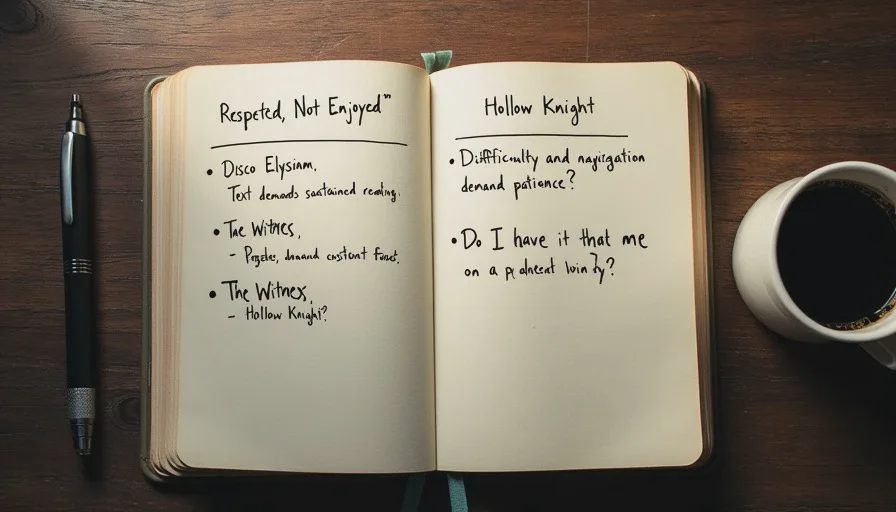
I'll close with the same principle that guides everything on this site. A good game does not just deserve praise. It deserves the right player, on the right night, with the right amount of energy. And sometimes, the right answer is to respect a game for what it is, close it, and go play something that actually gives you what you need. That's not a failure. That's self-knowledge.




No notes yet — write the first.