
Goodwill is a real resource in gaming. It's not listed in any design document, and it doesn't show up in your save file, but every player has it. When you start a game, you bring a certain amount of goodwill with you — a willingness to be patient, to trust the developer, to push through early friction because you believe the game will reward that patience. That goodwill is finite, and once it's spent, it's almost impossible to earn back.
I've been thinking a lot about this lately, because I've noticed a pattern. Certain games burn through my goodwill faster than others, and it's rarely the games that are openly demanding. A hard game tells you what it is. A complex game signals its complexity early. The games that waste my goodwill are the ones that pretend to respect my time and then quietly, gradually, stop doing so.
The most common way indie games waste a player's goodwill is simple, and it's devastating: they take too long to do what they set out to do. They pad. They stretch. They mistake length for substance. And somewhere around the midpoint, the player realizes they've been spending trust on a game that doesn't intend to pay it back.
How Goodwill Gets Built
Let me be clear about what I mean by goodwill, because it's not the same as enthusiasm. Enthusiasm is what you feel before you start. Goodwill is what you extend during the experience — the small, ongoing decisions to keep playing even when the game hits a rough patch.
A game builds goodwill by showing you, early and consistently, that it values your time. The opening hour is tight. The pacing is deliberate but purposeful. The game teaches you something new, rewards you for paying attention, and then moves on before the novelty wears off. You think: this developer knows what they're doing. I'll trust them.
That trust is worth more than any review score. It's what keeps you playing through a slow section, because you believe the slow section is building toward something. It's what makes you willing to re-read a dialogue line, or re-try a puzzle, or walk across a map one more time. Goodwill is the player's faith, extended on credit.
And too many indie games spend that credit on nothing.
The Padding Problem
Here's the specific way it usually happens. A game opens strong — tight pacing, clear purpose, a steady rhythm of new ideas. The first few hours fly by. You're engaged, you're curious, you're exactly where the developer wanted you to be. And then, somewhere around the midpoint, the game starts to slow down. Not because the story deepens or the mechanics evolve. But because the game has run out of things to say and isn't ready to end yet.
That's when the padding appears. It takes different forms, but it always comes from the same place: a game that has more runtime than content.
The recycled encounter
The game introduces an enemy type, a puzzle concept, a level mechanic, and then uses it again. And again. And again. Not in a roguelike way, where repetition is part of the loop and the variation comes from procedural generation. In a linear game, where you can feel the developer's hand reaching in and saying "we need another forty-five minutes, so here's that thing you already mastered."
I've played games where the final third consisted almost entirely of encounters I'd already solved in the first third. The game wasn't building on itself. It was circling back, draining the goodwill I'd extended during the promising opening.
The stretched traversal
Walking is fine. Walking across an empty map to reach the next objective, then walking back across the same map because the quest wants you to return to the quest-giver, then walking across it a third time because the next objective is on the other side — that's not fine. That's padding disguised as atmosphere.
Some of the most egregious examples of this are in games that are otherwise quite good. They have real ideas, real stories, real craft. But they've stretched their traversal times because someone decided the game needed to be longer. The result is a good six-hour game buried inside a mediocre ten-hour one.
The narrative stall
This one hurts the most, because it usually happens in games I was genuinely invested in. The story builds momentum, the characters develop, the stakes rise — and then everything pauses while the game sends you on an errand. Not a meaningful errand, not an errand that develops character or builds theme. Just a task, inserted to keep you busy while the runtime accumulates.
The worst version of this is the "collect three things to open the door" structure, which shows up in narrative games far more often than it should. Three keys. Three fragments. Three allies to recruit. The game has stopped telling its story and started managing your time.

How to Spot It Early
The frustrating thing about the padding problem is that it's hard to spot from the outside. Reviews often don't mention it, because reviewers play games in compressed periods and may not notice the repetition the way a weeknight player does. Trailers certainly don't show it. You have to learn to recognize the signs yourself.
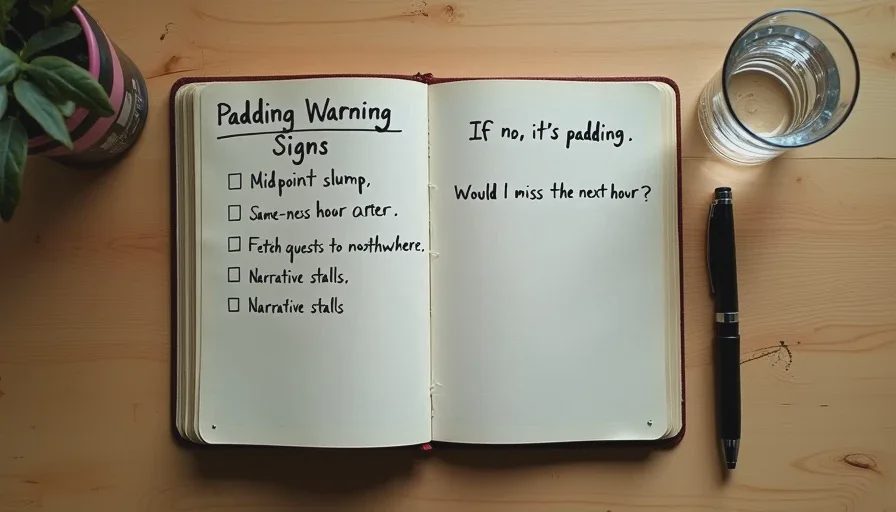
The midpoint slump
This is the most reliable indicator. When you're playing a game and you notice that your enthusiasm has dropped without a corresponding rise in narrative tension or mechanical complexity, the game is probably padding. A game that's building toward something will feel like it's building. A game that's padding will feel like it's treading water.
The same-ness test
Ask yourself: has anything meaningfully changed in the last hour? Not just new locations or new enemies, but new ideas. New mechanics, new narrative developments, new emotional beats. If the answer is no, and you're just doing variations on what you've already done, the game is spending your goodwill without earning it.
The "would I miss this" test
Here's a practical one. If someone told you the next hour of the game was going to be cut entirely, would you feel relief or disappointment? If it's relief, the game has already lost you. If it's disappointment, the game is still doing something right.
A Case I Keep Coming Back To
I recently played an indie game that exemplified this pattern perfectly. The first three hours were excellent — a unique central mechanic, a compelling mystery, and a pace that respected the player's intelligence. I was fully on board. I'd extended my goodwill willingly.
And then the game introduced a fetch quest. Not one fetch quest — a series of them, each requiring you to traverse areas you'd already visited, talk to NPCs you'd already met, and collect items you'd already seen. The mystery stalled. The pacing collapsed. The game had spent my goodwill on busywork.
I finished it, because I'm stubborn and I was writing about it. But I won't recommend it, because I know what the midpoint would do to a busy adult with limited evening hours. The game wasn't bad. It was padded. And the padding is what sticks with me, not the excellent opening.
The Real Cost
Here's the thing that bothers me most about the padding problem. It doesn't just waste the time you spend on the padded sections. It poisons your memory of the good parts.
I can't think about that game's excellent opening without also thinking about the fetch quests that came later. The padding didn't just add bad hours — it retroactively devalued the good ones. The trust I extended during the first three hours feels naive in retrospect, even though the opening genuinely was good. That's the real cost of wasting a player's goodwill. You don't just lose their time. You lose their willingness to trust you next time.
What a Good Game Does Instead
The games that earn my respect are the ones that end before they need to pad. They have a clear idea, a tight scope, and the discipline to stop when that idea is exhausted. They don't stretch their runtime to hit an arbitrary number. They don't insert busywork to justify a higher price tag. They trust that a shorter, tighter experience is worth more than a longer, diluted one.
That's what I look for now. Not length, not content volume, not "hours per dollar." Just the sense that every hour was intentional — that the developer valued my time enough to only include what mattered. A good game does not just deserve praise. It deserves the player's goodwill, and it earns that goodwill by spending it wisely, hour after hour, until the credits roll with nothing wasted.




No notes yet — write the first.