
I have a shelf in my Steam library that I don't open very often. It's full of games I genuinely admire. Games with hand-painted watercolor environments, moody synth soundtracks, lighting that made me stop and stare at the screen. Games that critics called "stunning" and "unforgettable." Games I have no intention of finishing.
That shelf exists because I've learned something the hard way: a beautiful game still isn't always worth playing. Art direction can pull you in, but it can't keep you there if the moment-to-moment experience doesn't respect your time. And for a busy adult, that gap between admiration and satisfaction is where a lot of evenings quietly disappear.
The Trap of Visual Seduction
Indie games are better than ever at making a strong first impression. A lush color palette, a carefully chosen typeface, a camera angle that feels cinematic — these things work on me every time. I'm not immune. When I see a game with a striking visual identity, I want to live inside it for a while. That's a legitimate pull. But I've also learned to ask a question that most trailers and review headlines never answer: what do you actually do after the first hour?
Because a beautiful opening is easy. Many games can deliver one. The harder thing is sustaining that feeling once the novelty wears off and the actual systems come into focus. I've played games where the first thirty minutes were among the best I've had in the medium, and the following three hours were a slow erosion of goodwill. Not because the art got worse — it didn't — but because the game underneath the art couldn't hold up its end of the bargain.
Beauty Is Not a Gameplay Loop
Here's the thing I keep coming back to: aesthetics are not a substitute for a satisfying loop. They're an amplifier. If the core interaction is good, beauty makes it better. If the core interaction is thin, beauty just makes the emptiness more noticeable, like putting a gorgeous frame around a blurry photograph.
I once played an indie game with some of the most evocative environments I've ever seen. The lighting was so good I'd walk into a new room and just stand there, moving the camera around, taking it in. But the actual gameplay — what I did from moment to moment — was almost entirely walking and occasional object interaction. After about ninety minutes, I realized I'd seen everything the game had to show me, and the remaining three hours would just be more of the same, with a story that wasn't carrying its weight.
That's not a broken game. It's a game that prioritized atmosphere over agency. And for some players, that's enough. But for me, on a Tuesday night after a long day, it wasn't. It was beautiful, and I was bored.

The Hidden Cost of Ambition
Sometimes the problem isn't that a beautiful game is empty. Sometimes it's the opposite: the game is so ambitious that its beauty becomes a tax. Environments that look incredible but take forever to traverse. Cutscenes that are lovingly animated but stretch on past their purpose. Interface design that is aesthetically coherent but functionally obscure.
I've played games that clearly had enormous care poured into every frame, and that care became part of the problem. The developer was so invested in every corner of their world that they forgot to ask whether the player's time was being well spent inside it. Every corridor was a gallery. Every interaction was a small ritual. Taken individually, each moment was lovely. Taken together, they were exhausting.
That's when beauty stops being a reward and starts being an obligation. You feel guilty for wanting to move faster, for skipping a scene, for not lingering in a space the developer clearly labored over. But a busy adult can't linger everywhere. The math of limited time demands triage, and a game that asks you to savor everything is asking for a kind of attention you may not have left.
The Difference Between a Screenshot and a Session
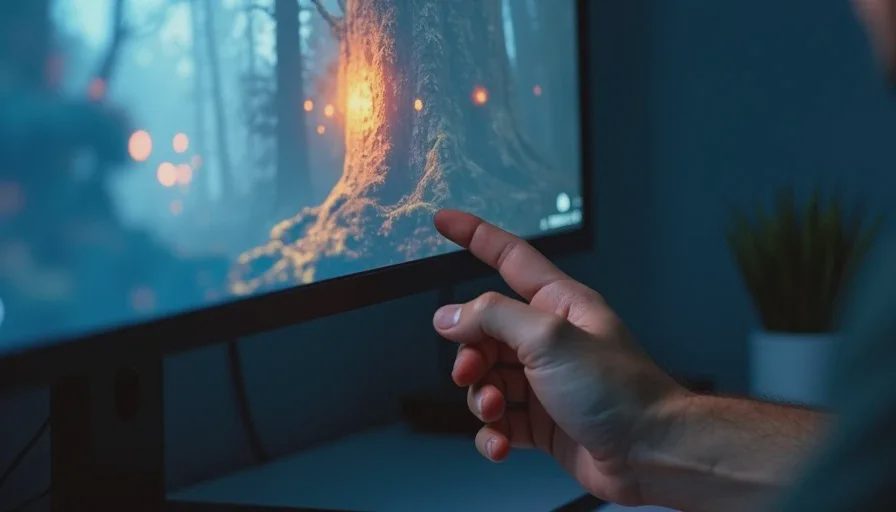
I've started using a simple test when I evaluate visually striking games: does this game feel as good as it looks?
It sounds obvious, but it's surprising how often the answer is no. A screenshot captures a mood. A session reveals whether that mood survives interaction. Some games look incredible in stills but lose their magic the moment you press a button — the movement feels floaty, the pacing drags, the world feels static once you're actually inside it. Other games don't have the most striking art, but they feel alive in your hands.
I've learned to be honest about which one I'm playing. There's no shame in admiring a game's visual design. But admiration is not a recommendation. I can think a game is gorgeous and still tell you not to buy it.
Who These Games Are Actually For
The tricky part is that beautiful-but-thin games often have a real audience. There are players who genuinely want a slow, atmospheric experience where the walking is the point. They want to soak in a space without pressure. For them, a game that I find empty might feel meditative and immersive.
The problem is that games coverage rarely makes this distinction. A game gets praised for its art, and the praise carries an implicit "you should play this." But the reviewer never stops to say: this is for someone who wants to wander, not for someone who wants to play. The beauty is treated as a universal virtue, when it's actually a specific fit.
I try to be the voice that asks the follow-up question. What kind of player does this beautiful game actually serve? If it's someone with a quiet afternoon and a desire to drift, I'll say so. If it's not someone with two hours after work and a need for something that gives back, I'll say that too. Both can be true. The game isn't bad because it's not for me. But it might not be worth your night.
The Shelf Stays Closed
That shelf in my Steam library — the one full of games I admire but won't finish — isn't a judgment on those games' quality. It's a judgment on fit. I keep them because they're beautiful, and beauty has value, and maybe one day I'll be in the right mood to wander through them without checking the clock.
But I won't pretend they're worth your Tuesday night just because they're stunning. A good game does not just deserve praise. It deserves your time, and it has to earn that time the same way everything else does: through the actual experience of playing, not the image it presents before you press start.
Next time you see a game that takes your breath away in a screenshot, don't ask if it's beautiful. Ask if it's worth playing. The answer might be yes. But if it's no, that doesn't make you shallow or impatient. It makes you someone with a life, and a limited number of evenings, and a right to spend them on games that give something back beyond a pretty frame.




No notes yet — write the first.