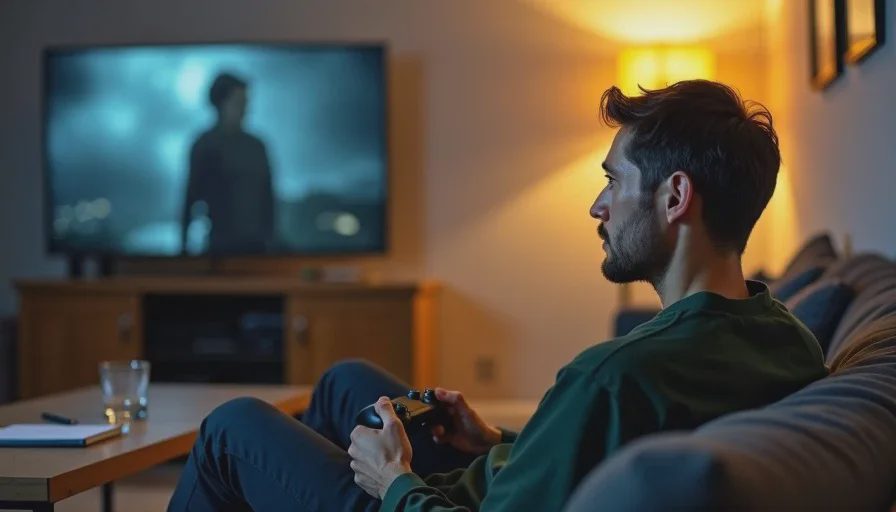
There's a category of game that sits apart from the usual labels. These aren't bad games. They're not disappointing games. They're often brilliant — formally inventive, emotionally ambitious, visually stunning. They get written about, discussed, analyzed. They push the medium forward. And yet, when I look at my library, I can see a dozen of them sitting unfinished, not because I ran out of interest, but because I realized something important: some games are better to admire than to actually finish.
That might sound like a dismissal. It isn't. It's a recognition that admiration and playtime are different resources, and they don't always need to be spent on the same object. You can deeply respect a game without needing to see its credits. You can appreciate what it's doing without signing up for the full experience. And for a busy adult, knowing the difference is the key to not wasting evenings on games that were never going to reward the time anyway.
Admiration Is Not a Command
The games media ecosystem is built on a simple assumption: if a game is good, you should play it. Reviews end with a score. Year-end lists tell you what you missed. The implicit message is always the same — this deserves your time because it's excellent.
But excellence alone doesn't justify your time. Your time is finite, and the fact that something is well made doesn't mean it's well made for you. A game can be a masterpiece of environmental storytelling and still be a poor fit for someone with ninety minutes on a Thursday night. A game can be mechanically fascinating and still feel like a chore to actually play.
The problem is that we're trained to feel guilty about this. If we don't finish the acclaimed game, we feel like we've failed somehow — failed the game, failed ourselves, failed the medium. That guilt is misplaced. It comes from confusing two different relationships: the relationship of an admirer to a work of art, and the relationship of a player to an entertainment experience. They overlap, but they're not the same thing.
The Three Types of Games I Admire But Won't Finish
Over the years, I've identified three broad categories of games that fall into this space. They're all games I genuinely respect. They're all games I've decided not to finish.
The Formal Experiments
Some games exist to test an idea. They're not really about the player experience in the conventional sense — they're about exploring a mechanic, a structure, a way of telling stories that hasn't been done before. These games are important. They advance the medium. And they're often deeply tedious to actually play.
I think about a game I played last year that used an unusual narrative structure — something involving parallel timelines that you could jump between at will. The idea was brilliant. The execution was mechanically sound. And after about two hours, I realized I'd gotten everything I was going to get from it. The structure was the point, and once I understood the structure, the act of playing through to the conclusion felt like going through the motions. I read about the ending later. It was interesting. I'm glad I didn't spend five more hours to see it myself.
The Aesthetic Experiences
Other games are built around a mood, an atmosphere, a feeling. They're less games than they are places you can visit. The art is stunning, the music is haunting, the world is rich with implication. But the actual gameplay — what you do from moment to moment — is thin.
These games are often described as "more art than game," which is meant as a compliment. And it is a compliment, in the sense that art is worth making and worth experiencing. But a game that's more art than game often means a game that's more passive than active. You walk. You look. You absorb. And for some players, that's exactly right. For me, on a Tuesday night after a day of meetings, it's not. I'd rather watch a video essay about the game than play it, because the video essay gives me the art without the walking.
The Misery Machines
This is the hardest category to write about, because these games are often the ones that get called "important." They're games about suffering — grief, trauma, systemic cruelty, personal loss. They're designed to make you feel something heavy, and they succeed. They're uncompromising, emotionally raw, and profoundly affecting.
And I don't want to play them after work.
That's not a criticism of the games. It's a boundary. I have a finite amount of emotional energy, and my weekday evenings are not where I want to spend it sitting inside someone else's pain. I can respect these games from a distance. I can read about them, think about them, recommend them to people who are in the right headspace. But I'm not going to spend my limited free time being made miserable, no matter how artfully it's done.
The Guilt Trap
The hardest part of this whole dynamic is the guilt. We're told, implicitly and explicitly, that finishing things is a virtue. That if you start a game, you should see it through. That walking away from a critically acclaimed experience is a kind of failure.
I've spent years unlearning that. And what I've found is that the guilt is almost entirely external. It comes from a culture that treats games as accomplishments rather than experiences. But a game isn't a mountain you need to summit. It's a relationship you enter into, and like any relationship, it's okay to realize it's not working and step away.
The games I admire but won't finish are not failures on my part. They're successful works of art that happen to not fit my life. I can appreciate them without completing them. I can recommend them to the right players without being one of those players myself. And I can do all of that without feeling bad about it.
A Better Way to Engage
Here's what I've started doing instead of forcing myself to finish games that aren't fitting. It's made my gaming life dramatically better.
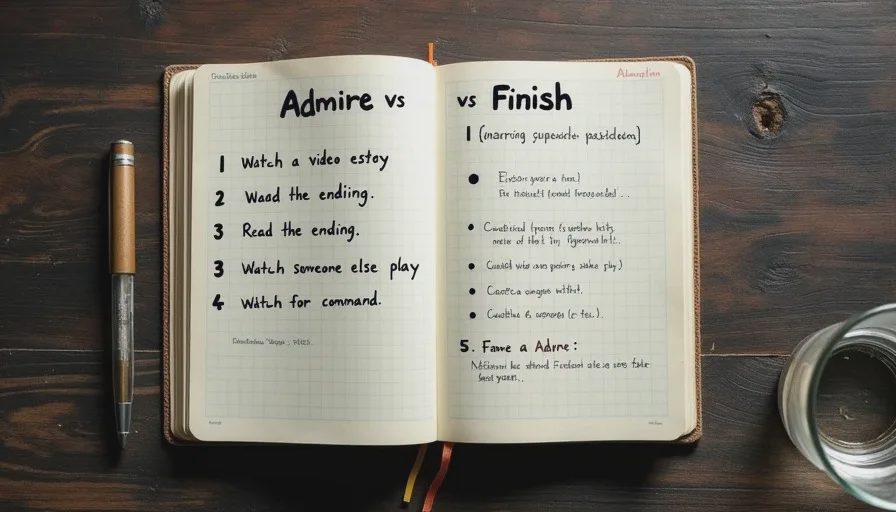
Watch instead of playing
If a game is a formal experiment, a video essay or a critical analysis will often give you everything you need: the ideas, the structure, the significance. You get the intellectual payoff without the time cost. This isn't cheating. It's a legitimate way to engage with a work you respect.
Read the ending
If a game is narratively ambitious but mechanically thin, reading about the ending can be more satisfying than slogging through to it. The story beats land, the themes resolve, and you haven't spent five hours walking between plot points.
Play it in someone else's hands
Streams and let's plays exist for a reason. Watching someone else play a game lets you experience the atmosphere without bearing the full weight of the interaction. It's not the same as playing, but sometimes it's better — especially for games that are more about mood than mechanics.
The Freedom of Honesty
There's a kind of freedom that comes from being honest about the games you admire but won't finish. Once you stop treating every incomplete game as a personal failure, you stop dreading your own library. You start making choices based on what actually fits your life, not what you feel obligated to complete.
That's the whole philosophy behind this column. I'm not here to tell you which games are good — you can find that anywhere. I'm here to tell you which games are good for you, specifically, with your limited hours and your post-work energy levels and your finite reserve of emotional bandwidth.
And sometimes the answer is: this game is brilliant, and you should appreciate it from a distance. Watch a video about it. Read an analysis. Respect what it did for the medium. And then go play something that actually fits your evening.
That's not giving up. That's being honest. And it's the only way to make sure your limited gaming time actually gives something back. A good game does not just deserve praise. It deserves the right kind of attention from the right kind of player — and sometimes, that attention is better spent from the outside looking in.




No notes yet — write the first.