There's a moment in nearly every game where I start to feel it. The subtle shift from "I'm enjoying this" to "I'm still playing this." The point where the mechanics stop developing, the story stops building, and the hours start accumulating anyway. It's the moment a game overstays its welcome — and it happens so gradually that you often don't notice until you're already past it.
What I've learned to value, maybe above everything else in this medium, is restraint. Indie games that end before they overstay their welcome are rare, and they're worth celebrating. They're games that could have gone longer. Games that had more ideas, more content, more world to explore. And they chose not to. They chose to end instead.
That choice matters. It's the difference between a game you remember fondly and a game you remember being tired of.
The Pressure to Pad
Let's be honest about the incentives here. Games are sold in hours. A $20 game that lasts four hours gets criticized for being "too short for the price." A $20 game that lasts forty hours gets praised for its "value," even if thirty of those hours are filler. The message to developers is clear: stretch it out. Add more content. Keep the player engaged for as long as possible.
This pressure produces a specific kind of bloat. It's not that games become bad — it's that they become diluted. The same ideas stretched over more hours. The same mechanics repeated with minor variations. The same story beats recycled until they lose their impact.
Indie developers are not immune to this. Some of the most bloated games I've played in recent years have been indie games that clearly felt they needed to justify their price tag with length. The result was a good four-hour game buried inside a mediocre twelve-hour one.
What Restraint Actually Looks Like
The games I want to talk about today are the opposite of bloated. They're games that understood exactly how long their ideas could sustain, and they built the entire experience around that understanding. They don't feel short. They feel right.
They develop their ideas fully, then stop
A game that ends before it overstays its welcome is not a game that runs out of ideas. It's a game that knows how many ideas it has and executes them all without padding the space between. Every mechanic gets explored. Every story thread gets pulled. Every emotional beat gets its moment. And then the game ends, because there's nothing left to do that wouldn't be repetition.
This is harder than it sounds. It requires a developer to look at their own work and say, "This is enough." To resist the urge to add just one more level, one more enemy type, one more twist. The games that pull it off are confident in a way that most games aren't.
They leave you wanting more, not less
This is the tricky part. A game that ends before it overstays its welcome makes you feel a specific kind of sadness when the credits roll. Not the sadness of a game cut short — the sadness of a good experience being over. You want more, but you know that wanting more is part of the design. The game ended exactly where it needed to, and your desire for more is proof that it worked.
That's different from the feeling of a game that's too short. A too-short game leaves you feeling cheated. A game that ends at the right time leaves you feeling full. The difference is subtle, but you can feel it in the moment.
They respect their own ending
A game that overstays its welcome often undermines its own conclusion. It builds to a natural endpoint, then keeps going. The emotional arc completes, and then another one starts. The story reaches a resolution, and then more story happens. By the time the actual ending arrives, the impact has been diluted by everything that came after the first ending.
Games that end before they overstay their welcome don't do this. They build to one ending, and they commit to it. The final scene is actually the final scene. There's no epilogue that stretches into a second act, no post-credits sequence that sets up a sequel you didn't ask for. Just the end, arriving exactly when it should.

Three Games That Get It Right
Let me be specific about what I mean. These three games could all have been longer. They chose not to be.
A Short Hike
A Short Hike is a game about climbing a mountain, and it knows exactly how long that climb should take. The island is small but dense, full of little interactions and hidden corners. You could explore for hours, and the game would happily let you. But the core experience — the climb, the discoveries, the final view from the summit — is designed to fit into a single afternoon.
What makes A Short Hike a model of restraint is that it doesn't punish you for wanting more. The island stays available after the credits. You can go back, wander, find things you missed. But the game itself — the thing it was trying to do — ends when it should. The mountain is climbed. The phone call is made. The experience is complete. Everything after that is optional, which is exactly how it should be.
Sable
Sable is a game about leaving home. You play as a young woman on a coming-of-age journey across a desert world, riding a hoverbike, meeting people, helping them, learning who you might become. There's no combat. There's no fail state. There's just the desert and the people in it and the choices you make about who to be.
Sable could have been much longer. The world is vast, and there are more quests than you need to finish. But the main path — the journey from departure to arrival — is paced with remarkable discipline. It ends when it should, and the ending lands because the game didn't stretch itself thin getting there. The desert stays with you after the credits, but the game is done. It said what it came to say.
Cocoon
Cocoon is a puzzle game about worlds within worlds. Each puzzle involves carrying orbs that contain entire environments, and the mechanics build and build until the final sequence, which is genuinely astonishing. The game takes about five hours to finish.
What impresses me most about Cocoon is that it never repeats itself. Every puzzle introduces something new or recombines old ideas in unexpected ways. There's no filler, no grinding, no padding. When the final puzzle resolves, the game ends. It could have added more — more orbs, more complexity, more hours. It didn't. And that restraint is exactly why it works.
The Counterexample I Can't Forget
A few months ago, I played an indie game that I won't name. It was a narrative adventure with a strong concept and a compelling first act. The first two hours were excellent — tight, focused, full of momentum. I thought I'd found one of those rare games that ends before it overstays its welcome.
Then it didn't end. The story reached what felt like a natural conclusion, and then it kept going. A new conflict emerged. A new area opened. A new set of characters appeared. By the time the actual ending arrived, I was exhausted. The game had taken a four-hour experience and stretched it to nine, and every hour after the fifth had weakened my affection for the whole thing.
That's the risk every game runs. The longer it goes, the more opportunities it has to disappoint you. A game that ends at the right moment locks in its impact. A game that overstays its welcome spends down that impact, one padded hour at a time.
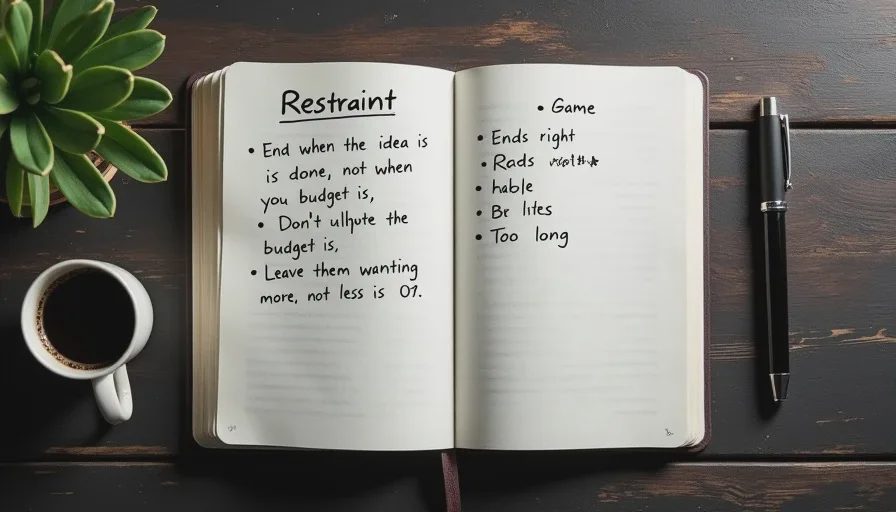
The Discipline of Ending
Ending a game is a creative act. It's not just stopping work because you've run out of money or time or ideas. It's making a judgment about what the experience needs and what it doesn't. The best indie developers understand this. They treat the ending as part of the design, not as the point where the design stops.
When a game ends before it overstays its welcome, it's making a statement. It's saying: this is the experience I wanted you to have, and I'm not going to dilute it with more of the same. That statement requires confidence, and it's exactly what I look for when I evaluate a game for this site.
The next time you finish a game and feel a small pang of sadness that it's over, pay attention to that feeling. If it's mixed with gratitude — if you're glad the game ended where it did, even though you wanted more — you've found one of the good ones. A game that knew when to stop. A game that ended before it overstayed its welcome. A game that earned your Tuesday night and then gave it back to you, intact, with the credits still warm on the screen.





No notes yet — write the first.