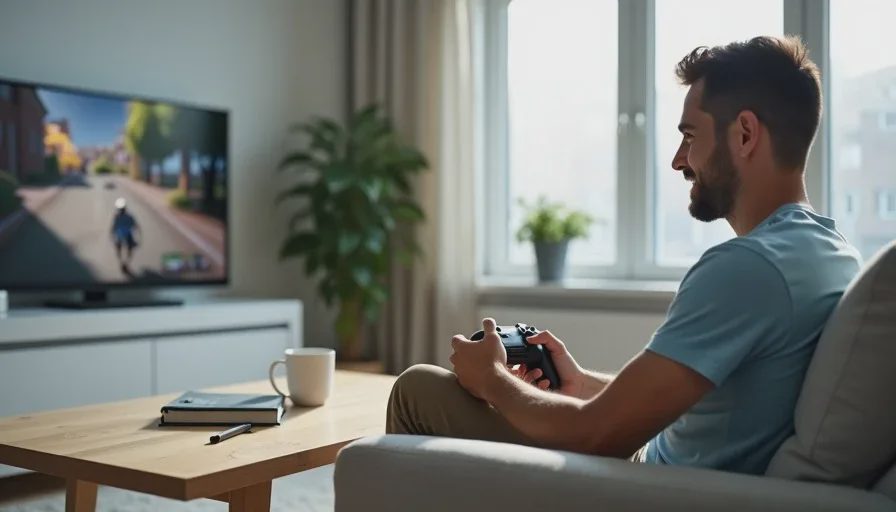
There's a specific category of game that doesn't get enough credit. It's not short enough for a weeknight session — you wouldn't start it at 9 p.m. on a Tuesday and expect to make meaningful progress before bed. But it's also not the kind of sprawling epic that demands weeks of commitment. It sits in a sweet spot: games you can start on a Friday evening and finish before Sunday night, with the credits rolling while you still have enough energy to feel good about your choices.
That window — roughly six to twelve hours of play, spread across two or three sessions — is one of the most satisfying ways to experience a game. You get the full arc, the complete emotional journey, the sense of having lived inside something for a concentrated period. And then it's over, and Monday arrives, and you don't have a half-finished save file nagging at you.
For busy adults, this is often the ideal format. Not every weekend works — some are full of errands, family obligations, or the simple need to do nothing. But when a quiet Friday evening opens up and you know you have Sunday afternoon free, a one-weekend game is exactly what you want.
What Makes a Game Right for a Weekend
Not every short game works for a weekend, and not every longer game fails. The key is how the game interacts with the shape of a weekend — the way sessions break across Friday night, Saturday afternoon, and Sunday evening.
It needs a natural session rhythm
A good one-weekend game breaks cleanly into two or three chunks. You can play for three hours on Friday, four on Saturday, and two on Sunday without feeling like you're stopping in awkward places. The game's structure — its acts, its chapters, its mechanical escalations — lines up with the way weekends actually flow.
Some games don't do this. They're designed for continuous play, and every time you step away, you lose momentum. A one-weekend game respects the fact that you'll be sleeping between sessions. It gives you natural stopping points that feel like endings, not interruptions.
It doesn't punish you for stepping away
Weekends involve life. You might need to pause to make lunch, answer a call, run a quick errand, or just take a walk because the weather turned nice. A good weekend game accommodates this. It saves generously. It doesn't have time-gated events or daily systems that demand you check in. It waits for you, patient as a book on a nightstand.
It builds toward a satisfying Sunday evening
The best one-weekend games understand that Sunday evening is its own thing. It's the closing scene of your personal weekend narrative. The game should build toward that moment — the final stretch, the emotional payoff, the credits rolling as you settle into the last hours before the workweek begins. When a game lands that Sunday-night ending, it stays with you all week.

Five Games Built for a Weekend
Here are five indie games I've personally finished in a single weekend, each one fitting the Friday-to-Sunday shape perfectly. They're different genres, different tones, different levels of challenge. What they share is a respect for the weekend format.
1. Hades
Time to finish: 10 to 12 hours for the main story arc
Hades is a roguelike, which might seem like an odd fit for a weekend recommendation. Roguelikes are built for repetition, and repetition usually means long-term commitment. But Hades is different. Its runs are short — thirty to forty minutes — and every run advances the story, even the ones where you die early. The narrative structure is woven through the runs, so you're always making progress, always learning something new about the characters.
What makes Hades perfect for a weekend is that its loop maps beautifully onto multiple sessions. Friday night: learn the basics, meet the characters, die a few times. Saturday: start to understand the systems, unlock new weapons, get further than you thought you could. Sunday: everything clicks, and the final escape attempt feels earned. By Sunday night, the main story resolves, and you can walk away satisfied — or keep playing, because the game has enough depth to sustain hundreds of hours.
I finished the main arc of Hades in one weekend. It was one of the best gaming weekends I've had in years.
2. Oxenfree
Time to finish: 4 to 5 hours
Oxenfree is a supernatural adventure about a group of teenagers who accidentally open a ghostly rift on an island. It's heavily dialogue-driven, and the way conversations overlap and interrupt each other feels more natural than almost any game I've played. The story is spooky, smart, and surprisingly emotional.
The whole thing fits into two evenings. I played the first half on a Friday night, got properly creeped out, and finished the rest on Saturday afternoon with the lights on. The game's structure — a single continuous night — is perfect for a concentrated playthrough. The longer you spend inside it, the more the atmosphere works on you. By the time the ending arrived, I felt like I'd been through something genuinely strange and affecting.
3. Katana ZERO
Time to finish: 4 to 6 hours
Katana ZERO is a neon-soaked action game about a hitman who can slow time and plan his attacks with precision. It's fast, stylish, and brutally efficient — one hit kills you, one hit kills your enemies, and every encounter is a puzzle of timing and positioning.
The story is darker than the flashy visuals suggest, dealing with addiction, memory, and the violence of the protagonist's life. It unfolds through short levels and cinematic interludes that keep the pace relentless. You can finish it in two sittings, and the game knows exactly how to use that tight structure — the final level lands with an impact that a longer, more padded game couldn't sustain.
I played Katana ZERO across a Saturday and Sunday, and the rhythm was flawless. Each level built on the last, and the ending hit hard. No filler, no downtime, just two afternoons of pure momentum.
4. The Forgotten City
Time to finish: 6 to 8 hours
The Forgotten City is a time-loop mystery set in a Roman city where everyone turns to gold if a single person sins. You arrive, you explore, you talk to people, and you learn the rules of the place. When the loop resets, you keep your knowledge, using it to probe deeper into the city's secrets.
The game is all about information — what you know, who you tell, and how you use what you've learned. It's the kind of game that rewards careful attention, and a weekend is the perfect container for it. The details stay fresh in your mind when the sessions are close together. You don't forget who said what, or which clue led where. By Sunday evening, all the threads come together, and the final reveal lands because you've been living inside the loop for two days.
5. Stray
Time to finish: 5 to 7 hours
Stray is a game about being a cat in a city of robots. That pitch sells itself. You explore a beautifully realized cyberpunk world from a cat's perspective, solving environmental puzzles and unraveling the mystery of what happened to the humans who once lived there.
What makes Stray a great weekend game is its pacing. It moves from small, intimate moments — scratching carpets, knocking objects off shelves — to larger narrative beats without ever losing momentum. The story is simple but effective, and the world is so richly detailed that you want to spend time inside it. I played it over two evenings and a Sunday morning, and the rhythm was perfect. Each session ended exactly when I wanted a break, and each one left me eager to come back.
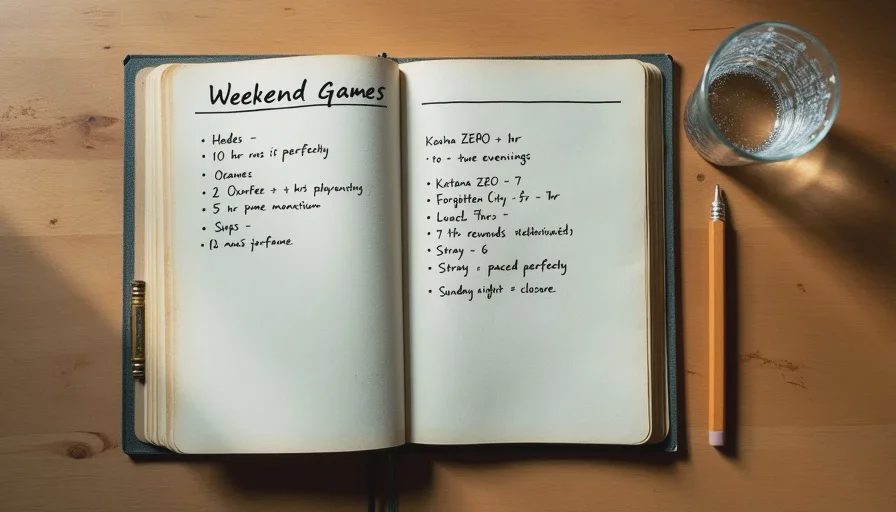
The Sunday-Night Test
I've started judging weekend games by a simple standard. When Sunday night arrives and I've finished the game, how do I feel? If the answer is "satisfied, and a little sad it's over, but ready for the week," the game did its job. If the answer is "frustrated, because I'm only halfway through and now I have to go back to work with a cliffhanger hanging over me," then the game was too long for the window I gave it.
The best one-weekend games are calibrated for this. They know that Sunday night is real, that the workweek is coming, that the player wants closure before they put the controller down. And they deliver.
Why This Format Works for Busy Adults
There's something uniquely satisfying about finishing a game in a single concentrated burst. You don't just play it — you live inside it for a few days. The characters stay in your head. The mechanics become muscle memory. The emotional arc stays present in a way that it doesn't when a game is stretched across months of interrupted sessions.
For busy adults, this is often the best way to experience a game. It respects the reality of your schedule while still giving you the full weight of a complete experience. You don't have to choose between gaming and having a life. You can do both, if you pick the right games.
The next time a quiet weekend opens up — no plans, no obligations, just you and a stretch of hours — pick one of these. Start it on Friday. Let it carry you through Saturday. And by Sunday night, you'll have the rare pleasure of finishing something. That's a good weekend by any measure.





No notes yet — write the first.