
Every few months, an indie game breaks through the noise and suddenly it’s all anyone in my gaming circles can talk about. The pitch is always the same: gorgeous art, a bold idea, a “you’ve never played anything like this” hook. And every time, I get the same question from friends: is this indie game actually worth my weekend?
It’s a fair question. A weekend isn’t nothing. If you’re like me — working a day job, keeping a household running, guarding a couple of free evenings with your partner — a Saturday and Sunday is a real block of time. You could spend it on a game, sure. But you could also spend it walking through a record store, making a decent pour-over, or just sleeping past seven. So before I tell you to clear your calendar, I want to walk through the filter I actually use.
The Hype Test: What Are People Actually Saying?
The first thing I do with any buzzy indie game is read past the adjectives. “Masterpiece,” “essential,” “unlike anything else” — these words tell me about the critic’s emotional state, not about the game. What I look for are concrete descriptions of what you do minute to minute, what the game asks of you, and how it treats your time.
A recent example: a game everyone in my group chat was calling “incredible” and “a must-play” turned out to be a slow, atmospheric exploration game with beautiful art and almost no traditional gameplay. That’s not a criticism. But it is a mismatch for someone hoping to spend a weekend actively engaged. The people recommending it weren’t wrong. They just weren’t being specific about what “incredible” meant for their actual play sessions.
So before I even install a game, I ask: what does a typical 45-minute session look like? If I can’t answer that from the reviews, the hype isn’t telling me enough.
The Weekend-Specific Question
Most game coverage assumes you can play a little every day. But for a busy adult, a weekend play session is different from a weeknight one. On a weeknight, I want low friction: something that starts fast and lets me stop without guilt. On a weekend, I have more room. I can tolerate a longer ramp-up, a more complex system, a game that asks me to hold a map in my head.
The question becomes: does this indie game reward the specific shape of a weekend?
Here’s what I mean. A game might be wonderful at 90 minutes per night, but if it takes 20 minutes just to re-learn what you were doing after a week away, then a weekend binge might actually be the wrong way to play it. Conversely, a game with a slow first hour might never survive a Tuesday, but on a Saturday morning with coffee, that same first hour might feel like a luxury rather than a tax.
I’ve made the mistake before of saving a dense, story-heavy indie game for a weekend, only to find that my weekend brain wanted something with quicker feedback. The result: I spent two hours frustrated with a game that I probably would have loved if I’d given it a quiet Tuesday night with lower expectations.
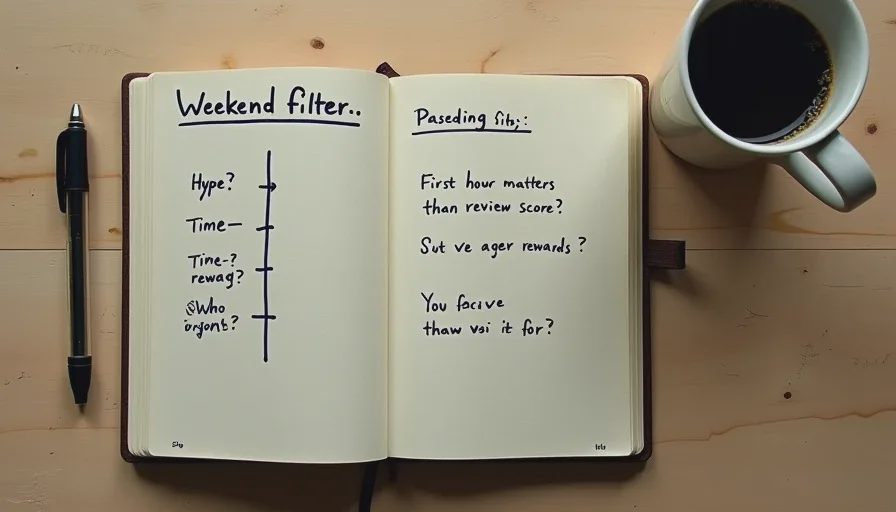
The Three Questions I Ask Before Committing a Weekend
So when a friend asks me if a game is worth their weekend, I don’t give a yes or no right away. I ask three questions, and I ask them in order.
1. What’s the actual time-to-reward?
Not the review score. Not the Steam rating. The real metric: how long until you feel something click? For some games, that’s five minutes. For others, it’s an hour or more. There’s nothing wrong with a slow build, but you need to know what you’re signing up for. If a game needs three hours to get good, that’s a real cost, and it’s one you should make knowingly.
I recently tried a critically praised indie game where the first 40 minutes were almost entirely walking and reading. The writing was excellent. But I kept checking the clock, because nobody had warned me that the “game” part didn’t start until well past the intro. If I’d known, I might have saved it for a rainy Sunday instead of trying to squeeze it into a Saturday evening after a long week.
2. Does this game respect my pace?
A good weekend game knows that I might have to pause to make lunch, answer a text, or walk the dog. It saves often, or it has a pause function that doesn’t make me lose my place. It doesn’t punish me for stepping away.
I’ve played games where saving meant losing 20 minutes of progress, and I’ve played games that let me stop mid-sentence and pick right back up. The second kind earns my weekend. The first kind earns my frustration. This seems like a small thing, but it’s the difference between a game that treats your time as a resource and a game that treats your time as an assumption.
3. Who is this game actually for?
This is the question most reviews skip. Not every good game is for every player. A punishing roguelike might be perfect for someone who wants a challenge to chew on all weekend, but it might be terrible for someone who just wants to relax. A narrative game with heavy themes might be meaningful for someone in the right headspace, but exhausting for someone who spent all week in meetings.
I try to be honest about this with myself. Sometimes I’m not the audience for a particular game, no matter how good it is. That doesn’t make the game bad. It just means it’s not worth my weekend.

A Small Case Study From Last Month
Last month, a well-regarded indie game landed in my library because a friend gifted it to me with a note that said, “You’ll love this. Trust me.” It had all the markers I usually respond to: a hand-drawn art style, a subdued soundtrack, a structure that promised short, meaningful sessions. I cleared a Saturday evening for it.
The first hour was exactly what I wanted. The game established a rhythm quickly, gave me a small but satisfying loop, and let me save whenever I wanted. I felt relaxed but engaged. Then, around the 90-minute mark, it introduced a new system — resource management across multiple runs — that completely changed the pace. Suddenly I was doing inventory math and worrying about optimization. The game hadn’t told me this was coming. If I’d known, I might have approached the first hour differently, or I might have waited for a weekend when I had more mental bandwidth.
I finished the game eventually, but that unexpected shift taught me something. A good game respects the expectations it sets. When a game changes the terms of engagement halfway through, it’s asking for a different kind of attention than you may have agreed to. That’s not always bad — some of my favorite games have surprising structural shifts — but it needs to be earned, and it needs to be communicated.
So, Is This Indie Game Worth Your Weekend?
I can’t answer that for every game, and I won’t pretend I can. What I can do is give you a filter that works better than the hype cycle.
Start with the time-to-reward. If a game asks for more patience than you have after a long week, that’s real information. Save it for a better moment or skip it entirely.
Check the pace and the save system. If a game respects your interruptions, it respects your life. If it doesn’t, it’s telling you something important about who it’s designed for.
Be honest about what you actually want from a weekend. Some weekends I want to be challenged. Some weekends I want to disappear into a story. Some weekends I just want to feel like I did something with my free time that wasn’t scrolling a phone. The right game depends on which one of those is true.
The next time someone tells you an indie game is “worth your weekend,” ask them one question: “What was the first hour actually like?” Their answer will tell you more than any review score ever will.
A good game does not just deserve praise. It deserves your Tuesday night — or your Saturday morning. But only if it earns the right shape of your time. That’s what Worth Your Night is here to help you figure out, one game at a time.




No notes yet — write the first.