I've abandoned more short games than I can count. Not because they were bad — many were lovely, clever, beautifully made. But because they stopped before they were done. They ran out of ideas, or budget, or nerve, and the ending arrived like a door slamming shut in the middle of a conversation. The credits rolled, and I felt something I couldn't quite name at first. Later, I realized what it was: the game hadn't been finished. It had merely been short.
The distinction matters. A game can be three hours long and feel whole. Another game can be three hours long and feel like a demo that escaped into the wild. The difference isn't runtime. It's whether the game completes the experience it started.
For busy adults, this is not an academic question. If you only have a few hours a week, every game you commit to is a real investment. When a game ends without feeling finished, you don't just lose those hours. You lose the trust that the next short game you try won't do the same thing.
The Telltale Signs of a Game That Merely Stops
I've started to recognize the patterns. They show up again and again, regardless of genre or art style or critical reception. A game that merely stops tends to do one or more of the following things.
It introduces a thread it never pulls
You meet a character who seems important. You find an object that clearly means something. You unlock a mechanic that implies a deeper layer of play. And then the game ends, and none of it comes back. The thread is left dangling, not as intentional ambiguity, but as a loose end the developer didn't have time to tie.
I played a game like this recently. It spent its first hour establishing a mystery around a sealed door. The door was framed as central — characters talked about it, the camera lingered on it, the whole map pointed toward it. The game ended at the ninety-minute mark. The door never opened. Not as a thematic choice, but because the game simply ran out of room. That's not mystery. That's incompleteness dressed up as restraint.
It skips the emotional payoff
A game can build tension, develop relationships, establish stakes — and then fail to deliver the moment those things were building toward. The final scene arrives too quickly. The confrontation you expected never happens. The emotional arc bends but never snaps.
This is especially common in short games that are trying to be subtle. Subtlety is a real tool, but it's not a substitute for resolution. A game can be quiet and restrained and still give you the release you've been waiting for. When it doesn't, the restraint stops feeling like confidence and starts feeling like avoidance.
It ends at the climax instead of after it
Here's a structural failure I see constantly. A game builds to a big moment — a revelation, a confrontation, a transformation — and then the credits roll immediately after. There's no denouement, no falling action, no chance to absorb what just happened.
Ending at the climax can work. Some of the most powerful endings in any medium cut to black at the moment of maximum impact. But that only works if the game has earned it — if the abruptness is a deliberate choice that reinforces the story's meaning, not a structural shortcut. Most of the time, ending at the climax just feels like the developer ran out of money or patience. You're left holding the emotional impact with nowhere to put it.
What a Finished Game Actually Does
So what's the alternative? What does a game do when it truly finishes instead of merely stopping?
It closes the loops it opened
A finished game doesn't have to resolve every detail. Ambiguity has its place. But the major threads — the ones the game itself told you were important — need to reach some kind of destination. The character who seemed significant needs to matter. The mystery that drove the first hour needs an answer, even if the answer is "there is no answer, and here's why that's the point."
The key word is intentionality. A finished game leaves loose ends on purpose, and you can feel the intention behind them. A game that merely stops leaves loose ends by accident, and you can feel the absence of intention.
It delivers the emotional release it promised
I'm not saying every game needs to make you cry. But every game sets an emotional contract with its player — a promise about what kind of experience this is going to be. A thriller promises tension and release. A comedy promises warmth and laughter. A melancholy game promises a certain kind of ache that resolves into something bearable.
A finished game honors that contract. The tension snaps. The laughter lands. The ache finds its shape. The game doesn't have to be happy, but it has to be complete — it has to deliver the emotional experience it spent its entire runtime building toward.
It gives you a moment to breathe
This is the part that gets skipped most often. A finished game gives you space after the climax — even if it's just a short scene, a quiet moment, a chance to sit with what just happened before the credits start. That space is where the experience settles. It's the difference between being hit by a wave and being pulled under by it.
The best short games understand this intuitively. They know that the ending isn't just the last event. It's the last event plus the moment after, the beat of stillness where the player processes what they've just been through. Games that skip this beat feel rushed, no matter how slowly they were paced before it.
The Structural Building Blocks of a Finished Game
When I analyze a game that feels genuinely finished, I notice a few structural elements that keep showing up. These aren't rules — there are brilliant games that break all of them. But as a general pattern, they're a useful way to understand why some games land and others don't.
A clear three-act shape
Not every game needs a traditional three-act structure, but every finished game has some kind of shape. A beginning that establishes context. A middle that develops and complicates. An end that resolves. When one of these pieces is missing or truncated, the whole thing wobbles.
Short games are actually well suited to this structure because the constraints force clarity. You can't hide a missing third act inside forty hours of side content. The shape is visible, for better or worse.
Rising stakes that actually rise
In a finished game, the tension increases as you approach the end. The challenges get harder, the stakes get higher, the emotional weight gets heavier. You can feel yourself climbing toward something.
In a game that merely stops, the stakes often plateau early. The last hour feels like the first hour, just with more stuff in it. Nothing is building. The game is running out the clock until the credits are allowed to appear.
An ending that reframes what came before
The strongest kind of finish is one that makes you see the earlier parts of the game differently. A revelation that recasts a relationship. A final image that gives new meaning to a recurring symbol. A choice that retroactively changes what you thought you were doing all along.
This is what separates a true ending from a mere stop. A stop just halts the action. An ending completes the meaning. It closes not just the events of the story, but the interpretation of those events. You leave the game understanding it differently than you did while you were inside it.
Why This Matters More Than You Think
I used to think "finished" was a nice-to-have. A game could be enjoyable even if the ending was weak, right? I don't believe that anymore.
The ending is the last thing you experience. It's the impression that stays with you after the screen goes dark. A game with a bad ending doesn't just botch its final minutes — it retroactively weakens everything that came before it. The hours you spent were building toward something, and if that something doesn't arrive, the hours themselves start to feel wasted.
This is especially true for busy adults. If you have limited gaming time, you're not just choosing what to play. You're choosing what experiences to carry with you. A game that ends well gives you something to keep. A game that merely stops leaves you empty-handed.
The Questions I Ask Before Recommending a Short Game
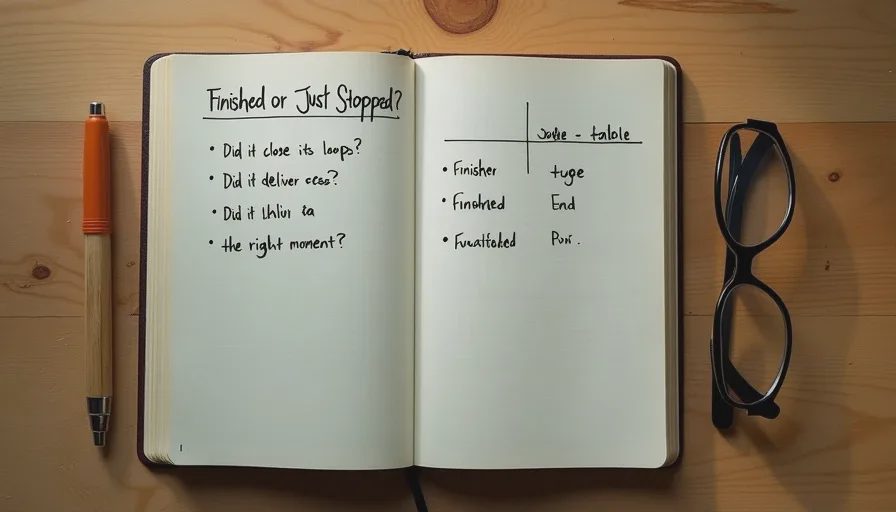
When I evaluate a short game for this site, I ask three questions about its ending. They're the same questions I'd ask about a long game, but they matter more here because the margin for error is smaller.
Did the game close what it opened? Not every thread, but the ones it told me were important.
Did I feel something resolve? Not necessarily happiness, but a sense that the emotional contract had been honored.
Would I have wanted more time, or did it end exactly where it needed to? If the answer is "I wanted more because it felt incomplete," that's a problem. If the answer is "I wanted more because it was good and I was sad it was over," that's a completely different thing — and a sign of a game that finished exactly right.
A short game that passes all three is rare. When I find one, I recommend it without hesitation — not because it's short, but because it's whole. That wholeness is what stays with you. It's what makes a Tuesday night feel like it counted. And it's what makes the difference between a game that ends and a game that finishes.





No notes yet — write the first.