
I need to be careful with this one, because I'm going to say something that sounds like a criticism but isn't. There's a game in my library that I genuinely admire. It's well designed. It's thoughtful. It has ideas I haven't seen anywhere else in the medium. And I would not recommend it to most of the people who read this site.
That's not a contradiction. It's the whole point of this column. A good game can still be wrong for most adults, and pretending otherwise is how busy players end up feeling like they've wasted their evenings on something that was never meant for them.
The game I'm talking about is Rain World. And this is going to be the least conventional "negative" review you'll read, because I'm not going to tell you it's bad. I'm going to tell you it's good — and that's exactly why most of you should skip it.
What Makes It Good
Rain World is a survival platformer about a small creature called a slugcat, trying to survive in a world that is actively hostile in ways that go far beyond typical video game enemies. The ecosystem is simulated. Predators hunt. Prey flees. Rain comes in devastating cycles that force you to find shelter before the world floods. Your slugcat is not powerful. It's fragile, slow, and near the bottom of the food chain.
The game is built around this vulnerability. You don't fight your way through the world. You sneak, hide, climb, and run. Death is common, and it's rarely dramatic — often, it's just the result of being in the wrong place when the rain comes, or stumbling into a predator's territory without realizing it.
What makes Rain World genuinely impressive is the commitment to its vision. The world doesn't care about you. It's not balanced for your convenience. Predators don't wait for you to learn their patterns. The rain doesn't pause because you're lost. The game refuses to soften its edges, and that refusal produces something that feels less like a designed experience and more like a place — a real, indifferent ecosystem that you happen to be visiting.
I respect that. I respect it enormously. And I also think it's a terrible fit for most adults with limited gaming time.

The Gap Between Respect and Recommendation
This is the distinction I keep coming back to on this site. Admiration is not the same as recommendation. I can admire Rain World for its uncompromising vision while also knowing that most of my readers — working adults with jobs, partners, and maybe two hours on a Tuesday night — would find it exhausting, frustrating, and ultimately unrewarding.
The gap isn't about quality. It's about fit. A game can be exactly what it set out to be and still be wrong for you. The question isn't "Is this game good?" The question is "Is this game good for me?"
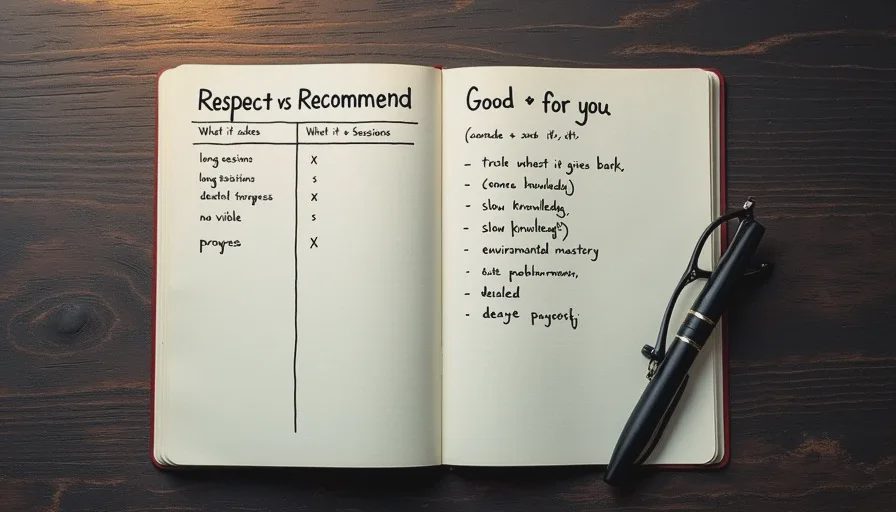
What it asks from the player
Rain World asks for patience in quantities that most busy adults don't have on weeknights. It asks you to accept death as a learning tool, to re-tread the same paths multiple times, to spend twenty minutes figuring out how to get past a single predator. It asks you to be okay with losing progress, with dying to things you couldn't have anticipated, with spending an entire session making zero visible advancement.
None of this is bad design. It's intentional. But it's a specific kind of experience, and it's one that fits a specific kind of player: someone with time to spare, with patience for slow progress, with a willingness to be defeated repeatedly in service of gradual mastery.
That player exists. I know some of them. But it's not the person I'm writing for.
What it gives back
The reward in Rain World is the slow accumulation of environmental knowledge. You learn which tunnels are safe, which predators can be avoided, which routes work during different parts of the rain cycle. Progress isn't measured in levels or story beats. It's measured in familiarity — the gradual shift from "everything here wants to kill me and I don't know where I am" to "I know this place, and I know how to survive here."
That's a real reward. But it's a slow one, and it takes many hours to arrive. If you only have a few hours a week, the ratio of frustration to payoff is going to be heavily skewed. You'll spend most of your limited time dying, lost, and unsure whether you're making progress at all.
Who This Game Is Actually For
I want to be fair here, because Rain World deserves better than "it's too hard." It's not a difficulty issue. It's a time-and-attention issue.
This game is for:
Players who want to be lost. Not in the "where do I go next" sense, but in the deeper sense of being dropped into a world that doesn't explain itself. If you enjoy that feeling — the disorientation, the gradual piecing together of understanding — Rain World is one of the best versions of it.
Players who have long, uninterrupted blocks of time. This is not a 40-minute session game. You need time to explore, to die, to re-trace your steps, to experiment with routes. If your gaming happens in short weekday chunks, you're going to spend most of those chunks frustrated.
Players who don't need visible progress. If you can enjoy a game session where nothing measurable changed — you didn't level up, you didn't advance the story, you just learned something about the world — then Rain World will reward you. If you need a sense of forward motion, it will fight you.
The Hardest Part of Writing This
Here's the thing that makes this column difficult. Rain World is a game I'm glad exists. I'm glad someone made it. I'm glad there are players who love it, and I understand why they do. The medium is better for having games that refuse to accommodate, that prioritize vision over accessibility, that trust the player to meet them on their own terms.
But my job here isn't to celebrate everything that's good. It's to help you figure out what's worth your time. And that requires a different kind of honesty — the kind that says "this is excellent, and it's not for you."
I've written before about the difference between "interesting" and "worth starting." This is a related distinction, but it cuts deeper. It's not just about whether a game is worth your evening. It's about whether a game deserves to be recommended to the specific audience I'm writing for, regardless of its quality.
And the answer, for Rain World, is no. Not because it's bad. Because it's good in a way that costs more than most busy adults should be asked to pay.
How to Apply This to Other Games
The next time you're reading a glowing review of a game that sounds exhausting, ask yourself a few questions.
What does this game ask from the player? Not in terms of difficulty, but in terms of time, attention, patience, and emotional energy. Does it ask for long sessions? Does it demand that you re-learn systems after a break? Does it punish mistakes harshly?
What does it give back, and how quickly? Is the reward immediate and regular, or is it slow and cumulative? Both are valid, but the second kind requires more investment before it starts to pay off.
Who is this game actually for? A game can be excellent and still be for someone with more free time, more patience, or a different temperament than yours. That doesn't make it bad. It just means it's not your game.
I'll close with the same principle that guides everything on this site: a good game does not just deserve praise. It deserves the right player. And if you're a busy adult with limited hours and a finite reserve of patience, Rain World probably isn't you. That's not a criticism of the game. It's just the truth.




No notes yet — write the first.