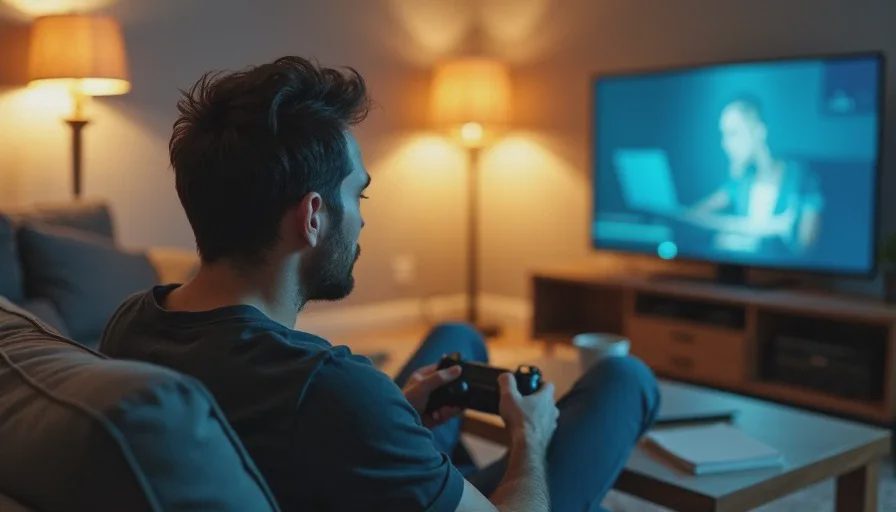
There's a specific kind of disappointment that only happens on a weeknight. You've read the reviews, watched the glowing video essays, added the game to your wishlist months ago. It finally goes on sale, or you finally treat yourself. Tuesday evening arrives. You sit down, coffee made, phone silenced, ready to experience something special. And then, forty minutes later, you realize you're not having a good time. You're not even having a bad time. You're having a wrong time — the game is clearly well made, clearly loved by many, and clearly not working for you in this moment.
I've been in that chair more times than I care to count. And I've learned that why some critically loved indie games feel bad on a Tuesday night has almost nothing to do with their quality. It has everything to do with the specific conditions of a weeknight: your energy, your attention, your mood, and the shape of the hours you have left before bed. A game that sings on a lazy Saturday afternoon can feel like sandpaper at 8 p.m. after a day of meetings.
The Tuesday Night Conditions
Let's be concrete about what a weeknight actually feels like for the adult player this site is written for. It's not just "less time." It's a whole constellation of constraints that interact with game design in predictable ways.
Diminished cognitive bandwidth
By Tuesday evening, you've spent two full days doing work that requires focus, communication, and decision-making. Your brain is not at peak processing power. Games that ask you to learn new systems, hold multiple threads in your head, or make rapid strategic choices are asking for resources you may not have left.
This is why a brilliant puzzle game can feel frustrating on a weeknight. The puzzles are solvable — you'd solve them on a Saturday — but on Tuesday they just feel like more work. The game hasn't changed. Your capacity has.
Low tolerance for friction
Friction is the small stuff: loading screens, slow walk speed, repeated dialogue, menus that take three clicks too many. On a weekend, you barely notice it. On a weeknight, every moment of friction is a small tax on your already-depleted patience. A game that's 5% friction might feel smooth when you're relaxed and generous. The same game feels like wading through mud when you're tired and your evening is finite.
The emotional weight problem
Some critically loved indie games are heavy. They deal with grief, loss, anxiety, moral compromise. That's not a flaw — it's often the reason they're celebrated. But there's a mismatch between a heavy emotional experience and a Tuesday night brain that's already carrying a day's worth of stress. You may simply not have the emotional capacity for a game that asks you to sit with someone else's pain for three hours.
This is not a criticism of those games. It's a recognition that emotional bandwidth is a real resource, and it gets spent on weekdays.
Three Specific Ways Acclaimed Games Clash With Weeknights
1. They front-load the experience
Many narrative-driven indie games are built like slow-burn novels. The first hour is setup: learning the world, meeting characters, establishing tone. That's not bad design — it's a legitimate structural choice. But on a Tuesday night, that first hour is a real cost. You're investing time and attention in a game that hasn't started paying back yet, and you're doing it with a brain that's already running low on patience.
I've started more than one acclaimed narrative game on a weeknight and bounced off the opening hour, only to return to it on a weekend and find that same opening hour rich and rewarding. The game didn't change. My ability to sit with a slow opening did.
2. They demand that you remember
Some games are built around continuity — not just save files, but mental continuity. You need to remember where you were, what you were doing, who the characters are, what the plot threads were. That's fine if you're playing every day. But if you're playing on Tuesday and won't return until Friday, the game asks you to hold all that context in your head for three days while you do your actual job.
Games that don't provide in-game recap tools or natural re-entry points become harder to return to. You end up either re-learning the context each session (which feels like homework) or giving up entirely because the thought of catching up is exhausting.
3. They treat the player's time as abundant
This is the subtle one. Some games are designed with the unspoken assumption that the player has hours to spare. Not in an exploitative way — just in a structural way. They pace their revelations slowly. They spread their rewards thin. They assume you'll explore the optional content because it's there, not because you necessarily want to.
On a weekend, that abundance feels generous. On a Tuesday night, it feels wasteful. The game is spending your time like it has plenty, and you're sitting there knowing you have maybe ninety minutes before you should probably go to bed.
A Case Study Without a Name
I won't name the game, because I don't want this to read as a takedown. But I want to describe a pattern I've hit repeatedly.
The game in question is a narrative adventure with gorgeous art and a slow, deliberate pace. It has a 92 on Metacritic, or whatever the equivalent is, and it's exactly the kind of game that gets called "important." I started it on a Tuesday night. The first forty-five minutes involved walking, reading, and absorbing atmosphere. The writing was excellent. The art was stunning. And I was deeply, thoroughly bored.
Not because the game was bad. Because the game was asking me to be patient at the exact moment I had no patience left. I wanted to like it. I could tell I would like it, under different circumstances. But in that moment, on that Tuesday night, it felt like an obligation. I closed it, and I haven't gone back — not because I gave up on it, but because I'm waiting for the right context. A quiet Saturday. A pot of coffee. Enough time to let the pace wash over me instead of fighting it.
That's the key insight. The game wasn't wrong. The night was wrong.
How to Spot a "Not Tonight" Game
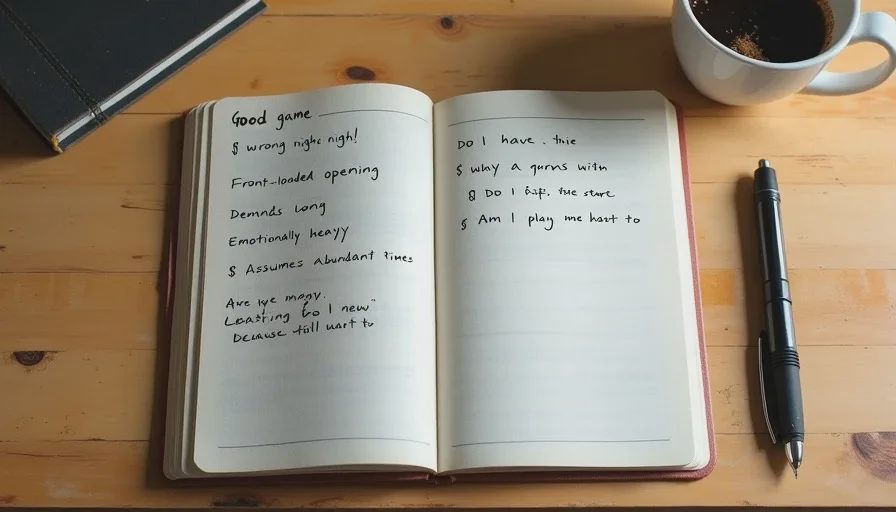
After enough Tuesday night misfires, I've developed a rough filter. Before I start a new game on a weeknight, I ask three questions.
Does it demand more than I have?
This isn't about difficulty in the mechanical sense. It's about resources: attention, patience, emotional availability. If I'm already running low, a game that asks for more is going to feel bad, no matter how good it is.
Does it respect the shape of a short session?
Can I play for forty minutes and feel like I did something? Can I stop without penalty? If the game requires long, continuous immersion, it's probably a better fit for a weekend.
Am I choosing it because I want it, or because I'm supposed to want it?
This is the hardest question to ask honestly. Hype is real, and it's especially seductive when you're tired. The idea of playing the game everyone's talking about feels more appealing than actually playing it sometimes. If I can't distinguish between the two, I wait.
The Conclusion I Keep Reaching
Critically loved indie games are not universally good for every context. They're good for certain players in certain moods with certain amounts of time. The Tuesday night player is a specific kind of player: depleted, time-limited, and looking for something that meets them where they are.
The games that work on a Tuesday night are not necessarily better than the ones that don't. They're just a better fit for the conditions. And the games that don't work — the slow-burn narratives, the demanding puzzles, the emotionally heavy art pieces — aren't bad. They're just not for this night. Maybe not for this week. Maybe not for you, if your life is shaped in a way that doesn't leave room for them.
That's not a failure of the game, and it's not a failure of the player. It's a mismatch, and recognizing it is part of being an honest, self-aware adult gamer. A good game does not just deserve praise. It deserves the right player, on the right night, with the right amount of energy. And sometimes, the right answer is to close it, wait for the weekend, and give it the attention it actually deserves — even if that means admitting it wasn't for your Tuesday night after all.




No notes yet — write the first.